Sub-Total: $0.00

Top Nursing Shoes for Women: 2026 Comfort & Performance
Your nursing shoes are not just a part of your uniform; they are the most critical piece of clinical equipment you’ll use all day. While a stethoscope monitors your patient’s heart, your footwear protects your own. You likely understand the exhausting reality of a 12-hour shift where hard hospital floors turn every step into a source of chronic foot and back pain. It’s a physical burden that many healthcare professionals simply accept, but your career longevity shouldn’t come at the cost of your physical well-being.
Finding the right comfortable nursing shoes for women is about more than just cushioning. It’s about reclaiming your energy and presenting a polished, professional image that moves away from the clunky styles of the past. This guide provides the ultimate framework for selecting footwear that stands up to fluid spills and slippery hallways while elevating your daily style. We’ll look at the 2026 standards for ergonomic performance and easy-to-clean materials that ensure your last step feels as supported as your first.
Key Takeaways
- Recognize how proper arch support acts as a long-term investment in your physical health, preventing chronic pain and lower back misalignment.
- Identify the essential 2026 features, including high-rebound midsoles and anatomical footbeds, that define truly comfortable nursing shoes for women.
- Evaluate the practical benefits of different silhouettes, from the unmatched stability of traditional clogs to the modern mobility of athletic sneakers.
- Use the afternoon fitting strategy to accurately assess how your footwear will perform during the final, most demanding hours of a 12-hour shift.
- Learn to curate a cohesive professional look that combines functional endurance with a sophisticated, lifestyle-oriented aesthetic.
Beyond the 12-Hour Shift: Why Nursing Footwear is a Career Investment
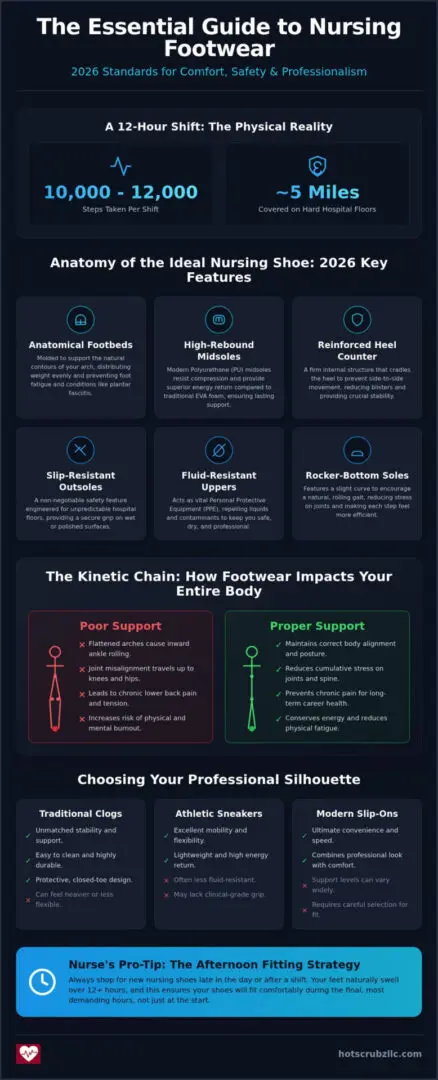
A typical nurse covers 10,000 to 12,000 steps in a single shift. That’s nearly five miles on unforgiving, hard surfaces. This isn’t just routine movement; it’s a high-stakes structural challenge for your body. Without a proper foundation, those miles lead to cumulative damage that extends far beyond the hospital doors. You deserve a footwear solution that works as hard as you do, protecting your health while you care for others. It’s time to view your shoes as a vital tool for your professional endurance.
Selecting comfortable nursing shoes for women is a strategic decision for your kinetic chain. When arch support is inadequate, your feet begin to flatten, causing your ankles to roll inward. This misalignment travels upward through your joints, often resulting in sharp knee pain and chronic lower back tension. Over months of shifts, this strain can develop into plantar fasciitis, a painful inflammation that threatens your ability to stay on your feet. High-quality footwear provides the stability needed to keep your body in balance and your mind focused on the task at hand.
Beyond physical health, your choice in shoes serves as a vital component of Personal Protective Equipment (PPE) for Healthcare Professionals. Footwear is your primary barrier against sharp clinical hazards and unexpected fluid exposures. Specialized medical shoes are designed to repel liquids and resist staining, ensuring that you remain protected from potential contaminants throughout your day. It’s about feeling ready, protected, and poised for whatever the shift demands, allowing you to move with a sense of professional pride and security.
The Link Between Foot Health and Professional Burnout
Physical fatigue is a primary driver of mental exhaustion in the healthcare industry. When your feet throb with every step, your cognitive load increases, making it harder to maintain the focus required for critical patient care. Reducing physical discomfort allows you to stay present and empathetic. If you don’t have to worry about burning soles, you can dedicate your full energy to your patients. Investing in premium footwear now prevents the chronic injuries that lead to early career exit, ensuring you can continue your vital work with confidence and ease.
Safety Standards in the Modern Clinic
Hospital floors are notoriously unpredictable. Between spilled fluids and freshly waxed hallways, slip-resistant outsoles are a non-negotiable safety feature. While standard athletic sneakers might offer temporary comfort, they often lack the fluid resistance and electrical hazard (EH) ratings required for clinical environments. True medical footwear is engineered for these specific risks, providing a secure grip and a surface that is easy to sanitize. This maintains high infection control standards without sacrificing your personal style or comfort during those long hours on the floor.
The Anatomy of Comfort: Key Features to Look for in 2026
Engineering has replaced guesswork in the search for the perfect clinical shoe. In 2026, the standard for excellence has shifted from simple “softness” to high-performance structural integrity. When you’re searching for comfortable nursing shoes for women, you’re looking for a sophisticated system that manages impact, stabilizes your gait, and protects your feet from the harsh realities of the hospital floor. It’s about finding a balance between immediate relief and long-term musculoskeletal health.
The foundation of this comfort starts with a reinforced heel counter. This internal structure wraps around the back of your heel to prevent side-to-side movement. Without it, your foot can slide within the shoe, leading to blisters and unstable steps. A firm heel counter works in tandem with an anatomical footbed. Unlike generic foam inserts that compress and lose their shape within weeks, anatomical footbeds are molded to support the natural contours of your arch and metatarsal bones. This ensures that weight is distributed evenly across your entire foot, rather than concentrating pressure on your heels or the balls of your feet.
Midsole Technology and Energy Return
The midsole is the heart of your shoe’s performance. While traditional EVA (Ethylene Vinyl Acetate) foam is lightweight and provides a “cloud-like” feel, it tends to break down quickly under the constant pressure of a 12-hour shift. Modern Polyurethane (PU) midsoles offer a more durable alternative; they resist compression set and maintain their supportive properties for much longer. Many 2026 designs also incorporate rocker-bottom soles, which feature a slight curve to encourage a natural gait progression and reduce the strain on your Achilles tendon.
Energy return in medical footwear is the capacity of a shoe’s cushioning system to absorb the kinetic energy of a footfall and redirect it back to the wearer to assist with the next step. This technology is vital for maintaining your pace during a busy afternoon. By returning energy rather than just absorbing it, these shoes help reduce the muscular effort required to keep moving, effectively fighting off the heavy-leg feeling that often sets in by hour ten.
Upper Materials: Durability Meets Hygiene
The exterior of your footwear must be as resilient as the interior is supportive. We’ve seen a material revolution where treated knits and advanced synthetic leathers provide a breathable yet entirely fluid-resistant barrier. These materials allow heat to escape while preventing liquid spills from penetrating the shoe. A reinforced toe box is equally critical, offering a layer of protection against dropped equipment or heavy rolling carts. Inside, moisture-wicking linings work to keep your feet dry, preventing the friction that causes painful blisters. If you’re considering the superior durability and easy-clean benefits of leather nursing shoes for women, you’ll find they offer exceptional fluid resistance and a polished aesthetic that holds up across hundreds of shifts. To ensure your gear stays as polished as your performance, consider upgrading to medical footwear designed for performance and aesthetic longevity.
Clogs, Sneakers, or Slip-Ons? Finding Your Professional Silhouette
Your role defines your movement. A nurse in a fast-paced emergency department requires a different level of support than a professional in a specialized outpatient center. Selecting comfortable nursing shoes for women is about identifying the silhouette that aligns with your specific clinical environment. Whether you prefer the structural stability of a clog or the agile feel of a sneaker, your footwear should enhance your professional presence while safeguarding your health. Your shoes are the foundation of your posture and the engine of your daily pace.
The Case for the Classic Nursing Clog
Surgical and ER staff frequently choose the classic clog for its unmatched vertical support. The slightly elevated heel helps redistribute pressure away from the lower back, which is essential when standing for hours at a bedside or in the operating room. While older versions were often criticized for being heavy, modern clogs utilize lightweight, high-density materials that offer a streamlined, polished appearance. They remain the most durable investment in medical footwear. Their solid construction provides a consistent fit that doesn’t break down, even after months of high-intensity use. Operating room professionals seeking the same level of ergonomic protection should also explore the best shoes for surgeons, which are engineered specifically for the prolonged standing demands of the OR environment.
The Rise of the Medical Athletic Shoe
For nurses who are constantly on the run, the medical athletic shoe has become the modern standard. These designs prioritize maximum mobility and a sporty, lifestyle-oriented aesthetic that feels fresh and energetic. They bridge the gap between high-performance runners and clinical tools by integrating specialized slip resistance into a lightweight frame. You can choose between the secure, custom fit of traditional laces or the rapid convenience of toggle lacing systems. These shoes ensure you stay light on your feet and ready for immediate action during the most demanding 12-hour shifts.
Professional slip-ons serve as the ideal middle ground for those seeking a balance of style and clinical utility. They offer the polished look of a professional loafer combined with the internal cushioning of a high-end sneaker. This silhouette is particularly effective in administrative or pediatric settings where a less “clinical” look is often preferred. Consider these departmental pairings to optimize your performance:
- Emergency & Surgery: Clogs for maximum back support and superior fluid protection.
- ICU & General Wards: Athletic sneakers for high-speed mobility and breathability.
- Administration & Specialized Clinics: Professional slip-ons for a sophisticated, authoritative aesthetic.
By matching your footwear to the pace and floor type of your department, you ensure that your gear supports your performance every step of the way. A well-chosen silhouette doesn’t just feel better; it helps you navigate your daily routine with more self-assurance and poise. Your choice in footwear is a reflection of your commitment to both your patients and your own professional well-being.
A Nurse’s Buying Guide: Selecting Shoes Based on Your Environment
Your workspace is the ultimate proving ground for your footwear. A nurse working on high-polish linoleum in a surgical wing has different requirements than one navigating the carpeted hallways of a long-term care facility. When you’re selecting comfortable nursing shoes for women, start by assessing your floor time. If you spend hours standing in one place, prioritize structural stability. If your role involves constant movement, focus on lightweight cushioning that absorbs the impact of every step. Your shoes should be a silent partner in your professional performance, providing the foundation you need to excel.
Timing is everything when it comes to a proper fitting. Shift-long comfort begins with the “End of Shift” test. Always try on new footwear in the late afternoon or after a day on your feet. Your feet naturally expand during a 12-hour shift, and a shoe that feels perfect during a morning fitting may become painfully restrictive by hour eight. By accounting for this natural swelling, you ensure that your shoes remain supportive and comfortable from the first patient check-in to the final hand-off of the day.
Sizing and Fit Essentials
Achieving the perfect fit requires more than just knowing your size. Follow the “rule of thumb” by ensuring there’s approximately a half-inch of space between your longest toe and the front of the shoe. This prevents painful compression and allows your toes to splay naturally. If you feel any pinching along the sides of your feet, consider moving to a wide-width model. A proper fit is also a safety essential. Integrating slip resistant nursing shoes into your uniform is a critical step in preventing workplace falls on slick, unpredictable clinical surfaces.
Footwear Rotation and Longevity
Give your shoes the recovery time they deserve. Rotating between two pairs of professional shoes allows the midsole foam to fully decompress and return to its original shape between shifts. This simple habit can effectively double the lifespan of your footwear and ensures that the shock absorption remains at peak performance. Even if the exterior looks pristine, plan to replace your shoes every six months if you’re working full-time. Once the internal support structure begins to collapse, you’ll feel the impact in your knees and lower back.
Maintenance is the final key to longevity. Use specialized cleaning protocols to keep your fluid-resistant uppers in top condition. Most modern synthetic materials can be easily sanitized with medical-grade wipes, which is essential for infection control. By caring for your gear, you maintain a polished, professional appearance that reflects your dedication to your role. If you’re ready to invest in your career endurance, browse our latest collection of high-performance medical footwear today.
Elevating Your Professional Presence with HotScrubz
Your clinical identity is a powerful tool. It speaks to your patients before you ever say a word, projecting a sense of competence and care. While the physical foundation of your shift depends on finding comfortable nursing shoes for women, your professional presence is completed by how you present yourself to the world. At HotScrubz LLC, we believe that aesthetic appeal and functional endurance are not mutually exclusive. You deserve a wardrobe that mirrors the high standards of your practice, allowing you to move through your day with a sense of prestige and self-assurance.
A polished appearance matters. It fosters immediate trust between you and those in your care. When you look composed and prepared, you signal a level of readiness that puts patients at ease during their most vulnerable moments. This isn’t just about vanity; it’s about professional pride. It’s about acknowledging the person behind the profession and ensuring they feel seen, supported, and stylish. Your uniform should be an asset that empowers your performance, not a distraction that limits it.
The Complete Look: From Footwear to Scrub Tops
Creating a cohesive clinical look starts with intentional coordination. Pairing your high-performance footwear with premium medical scrubs ensures a streamlined silhouette that is both safe and sophisticated. Avoid bulky, ill-fitting garments that can snag on equipment or hinder your movement. Instead, opt for modern cuts that complement your clinic’s dress code while allowing your personality to shine through. Consider these elements for a total professional package:
- Color Harmony: Coordinate your footwear with your scrub sets to create a unified, authoritative appearance.
- Leg Health: Integrate compression socks into your routine to support circulation and total leg health alongside your shoes.
- Fabric Performance: Choose materials that offer the same fluid resistance and durability as your medical footwear.
Ready for Readiness: Your Next Step
You’ve explored the science of midsoles, the importance of anatomical support, and the best silhouettes for your specific department. You understand that the right shoe is a career investment that protects your body for years to come. HotScrubz LLC is here to champion your journey by providing the tools you need to excel in a high-stakes environment. We value the dedication you bring to every shift, and we’re committed to helping you navigate your routine with more confidence. It’s time to elevate your daily experience. Upgrade your professional routine and discover a new standard of comfort and style by exploring our full collection of medical essentials today.
Step Into Your Professional Future with Confidence
Your professional journey is defined by the care you provide and the physical endurance you maintain. Selecting comfortable nursing shoes for women is the most significant step you can take toward preserving your health and your passion for clinical excellence. Throughout this guide, we’ve explored how anatomical support, modern materials, and proper fitting techniques create a foundation for long-term well-being. By choosing footwear that aligns with your specific clinical environment, you ensure that your gear works in harmony with your body rather than against it.
At HotScrubz, we offer empathetic support for healthcare heroes through style-forward, durable designs that stand up to the rigors of every shift. We believe you should feel as good as you look, even during the final hours of a demanding rotation. Take advantage of free shipping on qualifying orders to build a clinical wardrobe that inspires self-assurance and pride. Your dedication to others deserves a foundation that never wavers and a style that reflects your professional excellence.
Elevate your shift with HotScrubz medical footwear and apparel. You’ve dedicated your life to the care of others; let us provide the support and comfort your feet deserve.
Frequently Asked Questions
What are the most comfortable nursing shoes for women with high arches?
Look for footwear featuring built-in anatomical support and deep heel cups to distribute pressure across the entire foot. High arches require a structured footbed to prevent the foot from rolling inward and causing strain. While soft foam feels good initially, it doesn’t provide the long-term stability needed for a full shift. Finding comfortable nursing shoes for women with high arches often involves selecting professional models designed specifically for metatarsal relief and heel alignment.
How often should nurses replace their work shoes?
Plan to replace your professional footwear every six months or after approximately 500 miles of floor time. Even if the exterior looks pristine, the internal cushioning and structural support begin to collapse under the weight of repetitive 12-hour shifts. You’ll likely notice increased back or knee pain once the shoes have lost their integrity. Rotating two pairs is a smart way to let the foam decompress and extend the life of each pair.
Are sneakers or clogs better for 12-hour shifts?
The choice depends on your specific clinical duties and personal support needs. Clogs offer superior arch support and protection for professionals who spend long hours standing at the bedside. Sneakers provide the lightweight mobility required for fast-paced departments like the ER or ICU. Both styles are effective if they feature medical-grade slip resistance and easy-clean materials. Your department’s floor type and daily step count should guide your final decision.
What features make a nursing shoe truly slip-resistant?
True slip resistance comes from specialized rubber outsoles with micro-channel tread patterns. These designs are engineered to push fluids away from the contact point, ensuring your foot maintains a secure grip on wet or greasy hospital floors. Look for outsoles that meet professional safety standards for traction. This feature is a critical safety barrier that protects you from unexpected falls during high-stakes moments in the clinic, allowing you to move with confidence.
Can I wear regular running shoes for nursing?
Regular running shoes are often unsuitable because they lack the fluid resistance and lateral stability required in a hospital. While they offer cushioning, they’re designed for forward motion rather than the constant pivoting and standing of a clinical shift. They also tend to absorb spills, making them difficult to sanitize. Professional medical footwear provides specific safety features, like reinforced toe boxes and spill-proof uppers, that standard athletic shoes simply don’t offer.
How do I clean nursing shoes that have been exposed to bodily fluids?
Clean your footwear immediately using hospital-grade disinfectant wipes or a solution of mild soap and water. Most modern medical shoes feature non-porous synthetic leathers or treated knits that prevent fluids from soaking into the material. This makes them significantly easier to sanitize than standard mesh sneakers. Regular cleaning is a vital part of infection control and ensures your professional appearance remains polished and ready for your next patient interaction.
What is the best way to prevent foot pain during a long hospital shift?
The most effective way to prevent pain is to invest in comfortable nursing shoes for women that feature high-rebound midsoles and anatomical footbeds. Pair your footwear with compression socks to support circulation and reduce swelling in your lower legs. Taking micro-breaks to stretch your calves and rotating your shoes between shifts will also help. A proactive approach to your foundation ensures you stay focused on patient care rather than physical discomfort.
Why is arch support so critical for healthcare professionals?
Arch support is critical because it keeps your entire body in proper alignment. When your arches aren’t supported, your feet can overpronate, leading to a chain reaction of pain in your knees, hips, and lower back. Proper support redistributes your weight evenly, reducing the strain on your joints during those 10,000-step shifts. It’s an essential investment in your long-term musculoskeletal health and professional endurance, helping you navigate your daily routine with more self-assurance. Surgical professionals facing similar demands in the operating room can find specialized guidance in our resource on the best shoes for surgeons navigating prolonged OR standing.