Sub-Total: $0.00

The Anatomy of Professional Doctor Shoes: A 2026 Guide to Clinical Footwear
Your footwear is the most hardworking piece of medical equipment you’ll ever own. It’s the foundation of every twelve-hour shift and the silent partner in every patient consultation. Choosing the right doctor shoes isn’t just about fashion; it’s a critical decision for your long-term physical endurance. You deserve a foundation that works as hard as you do.
You understand the toll that a demanding clinical environment takes on your body. You’ve felt that persistent ache in your arches after a long day of rounds and the instability of navigating slick hospital floors. It’s frustrating when a single fluid spill ruins expensive footwear that wasn’t designed for the rigors of medicine. We’re here to help you move past those daily pains and elevate your professional experience.
In this 2026 guide, you’ll discover how to select high-performance footwear that balances musculoskeletal support with the professional style you deserve. We’ll break down the latest ASTM F2413-24 safety standards, the importance of the APMA Seal of Acceptance, and the innovative materials that make cleaning effortless. You’ll learn how to preserve your foot health while maintaining a polished, authoritative presence in every room you enter.
Key Takeaways
- Learn to distinguish between general athletic sneakers and footwear engineered specifically for the unique demands of a medical environment.
- Break down the three critical zones of footwear construction to find the perfect balance of shock absorption and stability for 12-hour shifts.
- Master the art of selecting doctor shoes that prioritize long-term musculoskeletal health without compromising your professional authority.
- Match your footwear to your medical specialty, choosing between the protection of traditional clogs or the agility of modern clinical sneakers.
- Discover how your choice of footwear impacts the drape and silhouette of your professional scrubs for a more cohesive, high-performance look.
Defining the Standard for Professional Doctor Shoes
Professional doctor shoes are precision instruments engineered for the high-stakes reality of modern medicine. They’re far more than a simple accessory; they’re the foundation of your clinical performance. Unlike standard footwear, these are designed specifically for the unique combination of static standing and rapid movement required during a demanding shift. True clinical footwear rests on three non-negotiable pillars: support that preserves your musculoskeletal health; safety that meets rigorous standards; and a style that reflects your professional authority. You aren’t just walking. You’re leading a care team, and your footwear should project that confidence.
The Evolution of Clinical Footwear
The journey from the heavy leather oxfords of the past to the sophisticated options of 2026 reflects a deeper understanding of physician well-being. Modern technology has moved beyond simple rubber soles, integrating high-rebound foams and ergonomic geometries into silhouettes that maintain a polished, professional look. The 2026 market shows a significant shift toward materials that prioritize both internal breathability and external fluid protection. These advancements allow you to maintain a high level of performance without sacrificing the prestige associated with your role. You can finally step into a pair that feels as good as it looks.
Why General Sneakers Fall Short in the Ward
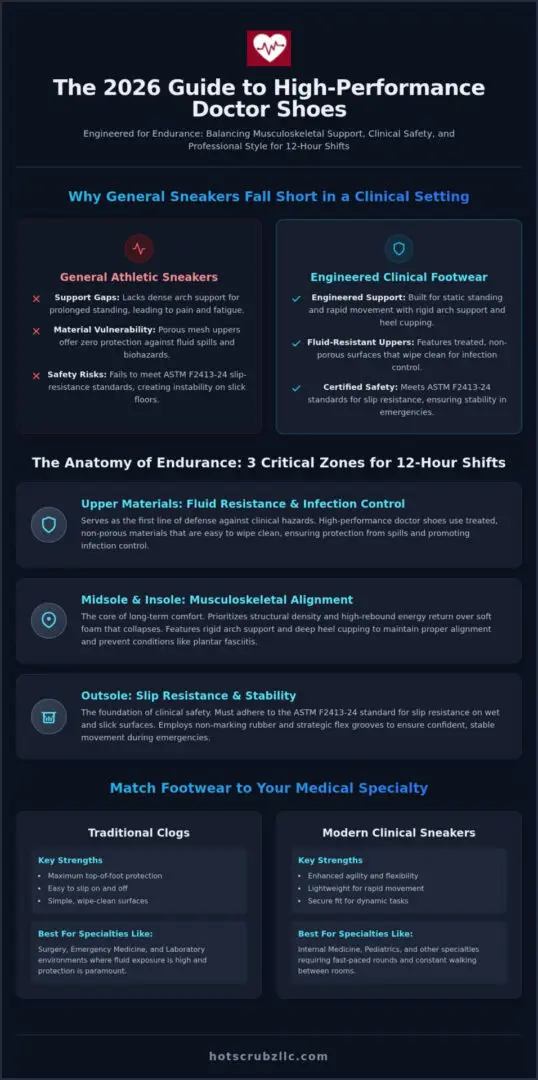
It’s tempting to reach for a favorite pair of running shoes, but general sneakers are often ill-equipped for the hospital ward. Most athletic shoes are designed for forward motion, whereas your day involves hours of static, vertical pressure. This difference in movement patterns requires a different engineering approach to ensure long-term comfort.
- Support gaps: Standard sneakers often lack the dense arch support required to prevent chronic heel pain during prolonged rounds. They compress too quickly under constant weight.
- Material vulnerability: Porous mesh uppers offer zero protection against the biohazards and fluid spills common in clinical spaces. Professional medical footwear uses treated surfaces that wipe clean in seconds.
- Safety risks: Many lifestyle sneakers fail to meet the current ASTM F2413-24 standards for slip resistance. On high-polish hospital floors, this lack of traction can lead to dangerous instability during emergencies.
Investing in dedicated doctor shoes ensures you’re protected by footwear that understands your environment. It’s about preserving your health so you can focus entirely on the health of your patients.
The Anatomy of Endurance: Engineering for 12-Hour Shifts
A high-performance shift requires more than just willpower; it demands precision-tuned engineering underfoot. Every component of professional doctor shoes must work in harmony to mitigate the physical toll of constant movement and static standing. When you’re on your feet for twelve hours, the difference between a productive day and chronic pain lies in the structural integrity of your footwear. Understanding the zones of your shoe helps you make an informed choice for your long-term health.
The Outsole: Slip Resistance and Stability
The foundation of clinical safety starts where the shoe meets the floor. Modern outsoles must adhere to the ASTM F2413-24 standard for slip resistance to ensure stability on wet or oily surfaces. It’s about more than just grip; it’s about confidence during an emergency. Non-marking rubber is essential for maintaining the integrity of hospital flooring, while strategic flex grooves allow for a natural gait. This balance ensures you can move quickly without the risk of a slip or a stumble.
The Midsole and Insole: Musculoskeletal Alignment
While some brands rely solely on soft memory foam, professional-grade footwear prioritizes structural density. Soft cushioning alone often collapses under the weight of a long shift, leading to fatigue. You need a midsole that provides high-rebound energy and rigid arch support to maintain proper alignment. Deep heel cupping is vital for preventing conditions like plantar fasciitis. Many clinicians find that choosing medical footwear with removable insoles allows for the seamless integration of custom orthotics, ensuring a personalized fit that supports your unique stride.
Upper Materials: Fluid Resistance and Infection Control
The upper portion of the shoe serves as your first line of defense against clinical hazards. In an environment where fluid spills are common, porous mesh is a liability. High-performance doctor shoes utilize treated leather or advanced fluid-resistant synthetics that are entirely wipeable. This is a non-negotiable feature for effective infection control. Beyond protection, look for wide toe boxes that accommodate the natural foot swelling that occurs by the tenth hour of a shift. Seamless construction further reduces pressure points and blisters. Combined with moisture-wicking liners, these materials ensure your feet stay dry, cool, and comfortable from the first round to the final chart.
Comparing Clinical Footwear: Clogs, Sneakers, and Beyond
Choosing the perfect pair of doctor shoes requires an honest assessment of your daily movement patterns. A surgeon standing for six hours in a theater has vastly different needs than a pediatrician moving between exam rooms. While engineering provides the foundation, the specific silhouette you choose defines your comfort and professional presence throughout the day. It’s about matching your gear to your grind.
The Surgical Clog: A Legacy of Support
Traditional clogs remain a staple for a reason. The slightly elevated heel profile is a deliberate design choice that shifts weight away from the Achilles tendon, reducing strain during long periods of static standing. Because they lack laces, these shoes eliminate a common trap for contaminants. This makes them incredibly easy to sanitize between cases. Modern iterations have shed the clunky reputation, offering streamlined shapes that pair perfectly with tailored scrub pants. You get the benefits of a legacy design with a contemporary, polished aesthetic.
The Performance Sneaker: Agility in the ER
In high-mobility environments like the Emergency Room, agility is your greatest asset. Clinical sneakers prioritize lightweight construction and maximum breathability to keep you cool during high-intensity moments. However, a standard gym shoe won’t suffice. You need a model that offers superior lateral stability to support sudden pivots and rapid movements without risking an ankle roll. These shoes bridge the gap between athletic performance and clinical necessity, ensuring you’re ready for whatever comes through the doors next.
For those in outpatient or administrative roles, the professional oxford or loafer offers a sophisticated look without sacrificing the internal support systems discussed earlier. These styles allow you to transition seamlessly from a patient consultation to a leadership meeting. Additionally, keep an eye on the emerging category of hands-free footwear. These innovative designs allow you to step in and out of your shoes without using your hands. It’s a game changer for maintaining sterile boundaries in surgical transition zones. Your footwear should be as adaptable as your expertise.
Selection Criteria: Matching Footwear to Your Medical Specialty
Your workflow is unique; your doctor shoes should be too. While every clinician needs support, the physical demands of your specific specialty determine which features matter most. A surgeon’s day is defined by endurance in a single spot, while an ER doc’s day is a series of high-speed sprints. Selecting the right footwear means acknowledging these different realities to protect your long-term health and enhance your professional presence.
Surgeons and Anesthesiologists: The Static Standing Challenge
In the OR, anti-fatigue properties are your primary concern. When you’re standing for hours, gravity is your constant opponent. Closed-back designs are essential here, providing the structural stability needed to prevent foot fatigue and accidental slips. To maximize your comfort, consider integrating high-performance compression socks with your footwear. This combination promotes healthy venous return, reducing the swelling and heaviness that often follows a long surgical case. You need a foundation that remains stable even when you are stationary.
The Resident’s Choice: Versatility for Rounds
Residents face the ultimate endurance test, often covering miles during extended shifts. You need a hybrid shoe that offers the professional silhouette of a traditional loafer but packs the internal technology of a high-end trainer. Durability is non-negotiable when you’re on the ward for eighty hours a week. Opt for neutral color palettes that transition seamlessly from a busy morning on the floor to a formal afternoon lecture. It’s about maintaining visibility and prestige without sacrificing your physical well-being.
For ER and trauma physicians, traction and agility are the priorities. You need footwear that handles rapid pivots and sudden movements on unpredictable surfaces. Conversely, pediatricians and family medicine practitioners often prefer an approachable, modern style. A friendly, less clinical appearance helps build rapport with younger patients while providing the all-day comfort needed for back-to-back consultations.
Before committing to a new pair, put them to the “3-mile shift” test. Large hospital complexes often require you to cover significant distances between wards. Walk in your potential choice during the late afternoon when your feet are naturally at their largest. This ensures the toe box remains accommodating even during the final hour of your shift. If you’re ready to upgrade your professional kit, explore our curated selection of high-performance medical footwear designed for every specialty.
Completing the Professional Look: Integrating Footwear and Apparel
Your professional presence is a holistic experience. While the internal engineering of your doctor shoes protects your body, their external appearance reinforces your authority. A polished, head-to-toe look does more than satisfy a dress code; it builds immediate patient trust. When you look composed and prepared, you project a sense of reliability that calms those in your care. Integrating your footwear with your professional wardrobe is the final step in mastering your clinical environment. It’s about feeling confident and looking the part.
Footwear and the Professional Silhouette
The interaction between your shoes and your scrub pants defines your silhouette. If you prefer tapered joggers, a streamlined clinical sneaker prevents a bulky, disconnected look. For those who wear straight-leg or boot-cut styles, a more substantial clog or oxford ensures the fabric drapes cleanly without dragging on the hospital floor. Even the height of your shoe plays a role. A slightly elevated heel can improve the visual balance of a professional lab coat, ensuring you look sharp during rounds. Footwear is also your best opportunity to inject personal style into a standard uniform. Whether it’s a subtle pop of color or a sleek, monochromatic finish, your choice reflects the person behind the profession.
The HotScrubz LLC Commitment to Clinician Comfort
At HotScrubz LLC, we believe you shouldn’t have to choose between functional endurance and aesthetic appeal. Our medical footwear collection is curated specifically for the modern clinician who values both. We understand that total readiness requires a cohesive system. Pairing your high-performance doctor shoes with essential nurse accessories like compression socks and organized totes ensures you’re prepared for the physical and logistical demands of your shift. It’s a comprehensive approach to your workday well-being.
To maintain your investment and your professional appearance, prioritize consistent care and rotation. Shoes that are scuffed or worn down don’t just lose their support; they can diminish the polished image you’ve worked hard to build. Consider these final tips for your clinical wardrobe:
- Sanitize daily: Use medical-grade wipes to keep uppers free from clinical contaminants and looking like new.
- Rotate your pairs: Giving your shoes 24 hours to decompress preserves the foam’s integrity and helps prevent odor buildup.
- Monitor wear: Replace your footwear every 4 to 6 months, or sooner if you notice the traction beginning to fade.
Building a professional wardrobe that supports your physical well-being is an act of self-care. When you invest in your appearance and your comfort, you’re investing in your ability to provide exceptional care for others. You’ve earned a look that works as hard as you do.
Elevate Your Clinical Foundation
Your choice of footwear is an investment in your career longevity and daily well-being. By prioritizing the intersection of musculoskeletal support and professional authority, you ensure that every round is met with confidence. You’ve learned how to decode the engineering of endurance and how to match specific silhouettes to the unique demands of your medical specialty. High-performance doctor shoes are not just a uniform requirement; they’re the silent partners that carry you through the most challenging moments of your day.
We’re dedicated to empowering the modern healthcare professional with gear that works as hard as you do. Our collection is specifically engineered for 12-hour endurance, ensuring you never have to sacrifice style for physical ease. Take the next step toward a more comfortable, polished professional life. Elevate your shift with professional medical footwear from HotScrubz and enjoy free shipping on qualifying orders. You dedicate your life to the care of others. It’s time to choose footwear that cares for you.
Frequently Asked Questions
What are the best shoes for doctors who stand all day?
The best shoes for long shifts prioritize structural support over simple softness. Look for footwear with high-density midsoles that don’t collapse under constant vertical pressure. A wide toe box is essential to accommodate the natural swelling that happens by the tenth hour of work. While memory foam feels good initially, dense arch support is what prevents chronic pain during rounds. Selecting professional-grade doctor shoes ensures your foundation remains stable and supportive from the first patient to the last.
Do doctors have to wear specific types of shoes in the hospital?
Requirements vary by facility, but most hospitals mandate slip-resistant footwear that meets ASTM F2413-24 standards. Employers must conduct hazard assessments to determine if protective toe caps or electrical hazard protection are necessary for your specific role. Even without a strict mandate, choosing professional clinical footwear is a standard best practice for infection control and personal safety. It’s always wise to check your department’s specific safety protocols before making a final selection for your wardrobe.
Are clogs better than sneakers for surgeons?
Clogs are often the superior choice for surgeons due to their elevated heel profile, which reduces strain on the Achilles tendon during static standing. The laceless design also makes them easier to sanitize after fluid exposure in the OR. However, if your role involves rapid movement between different wards, a high-performance clinical sneaker might offer better lateral stability. Your choice should reflect whether you spend more time standing in one spot or moving quickly through the hospital.
How often should a doctor replace their work shoes?
Most clinicians find that replacing their footwear every four to six months is necessary to maintain proper support. The internal cushioning and structural foams in medical shoes lose their rebound capacity over time, even if the exterior looks intact. You should also monitor the outsole for any signs of fading traction. Rotating between two different pairs can extend the life of each, giving the materials time to decompress fully between your 12-hour shifts.
Can I wear regular running shoes as a doctor?
Running shoes are designed for forward motion rather than the static standing and frequent pivoting found in a hospital. Their porous mesh uppers offer very little protection against fluid spills or biohazards. Additionally, many lifestyle sneakers lack the specific slip-resistance required for high-polish clinical floors. While they may feel lightweight, they often fail to provide the dense arch support needed to prevent plantar fasciitis during the repetitive, long-duration shifts typical for medical professionals.
What features make a shoe “fluid-resistant” for clinical settings?
A fluid-resistant shoe features a non-porous upper made from treated leather or high-grade synthetics. These materials act as a barrier against spills and biohazards, preventing liquids from reaching your skin. Look for wipeable surfaces that allow for immediate sanitation with medical-grade wipes. Seamless construction also plays a role by eliminating small gaps where fluids could collect. This design is a non-negotiable requirement for maintaining effective infection control and personal hygiene in any clinical environment.
How do I prevent foot pain during a 12-hour shift?
Preventing pain starts with footwear that offers deep heel cupping and rigid arch support to maintain proper musculoskeletal alignment. Pairing your shoes with high-quality compression socks can significantly reduce swelling by promoting healthy venous return. It’s also helpful to rotate your shoes, as this prevents the same pressure points from being stressed two days in a row. Taking small opportunities to stretch your calves and arches during charting moments can also help manage tension throughout the day.
Are there professional-looking doctor shoes that aren’t white clogs?
The modern market offers a diverse range of doctor shoes that move far beyond the traditional white clog. You can find sleek clinical sneakers, professional loafers, and even sophisticated oxfords that incorporate full medical-grade support. Many of these styles come in deep navy, charcoal, or classic black to coordinate seamlessly with premium scrubs. These contemporary designs allow you to maintain a polished, authoritative appearance while enjoying the high-performance features required for a demanding day in the clinic.