Sub-Total: $0.00

Black Nursing Shoes: The 2026 Guide to Style and Shift-Long Comfort
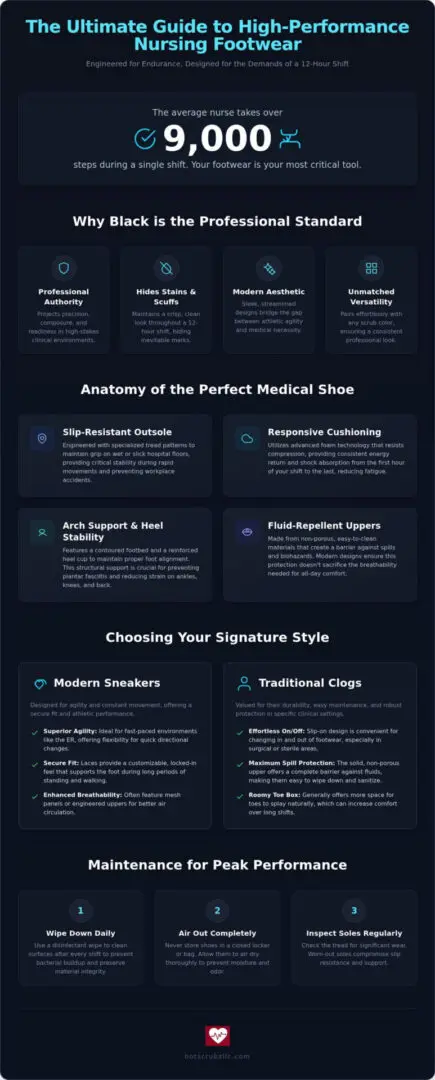
Last Tuesday, Sarah realized halfway through her rounds that her focus wasn’t on her patient’s charts, but on the sharp, radiating pain in her heels. You’ve likely been there, feeling the weight of a long shift settle into your lower back because your footwear failed you. With the average nurse taking over 9,000 steps during a single shift, your choice of black nursing shoes is the most critical tool in your professional kit. You deserve a pair that works as hard as you do without sacrificing the polished, modern aesthetic you’ve worked so hard to cultivate. We understand the frustration of choosing between clunky, dated designs and the professional appearance you want to project.
This guide is designed to end that compromise by helping you select footwear that protects your body and elevates your clinical style. You’ll discover how the latest 2026 material technologies provide effortless cleaning and why ergonomic support is non-negotiable for your career longevity. We’ll explore the intersection of high-performance endurance and professional visibility, ensuring you feel empowered from the moment you clock in until the final handoff. It’s time to find a pair that supports your journey and complements your premium scrubs with effortless ease.
Key Takeaways
- Discover why black nursing shoes remain the definitive professional standard for projecting authority and maintaining a sleek clinical aesthetic.
- Identify the critical anatomical features, such as slip-resistant outsoles and responsive cushioning, that provide true endurance for your longest shifts.
- Compare the biomechanics of modern sneakers and traditional clogs to determine which signature style best supports your specific clinical role.
- Master essential maintenance rituals to preserve material integrity, prevent bacterial buildup, and keep your footwear looking pristine.
- Learn how to integrate high-performance footwear with premium scrubs to elevate your professional presence without compromising on personal comfort.
Why Black Nursing Shoes are the Professional Standard in 2026
The clinical environment is changing, and so is the uniform. For decades, sterile white was the mandate, but 2026 has ushered in a more sophisticated era of medical attire. Choosing black nursing shoes isn’t just about following a trend; it’s about claiming a sense of authority and readiness before you even step onto the floor. Black suggests a level of precision and composure that lighter colors often lack. It creates a visual anchor for your entire ensemble, signaling to patients and colleagues alike that you’re prepared for the complexities of the shift ahead.
Beyond the psychological edge, the practical benefits are undeniable. In a high-stakes environment where exposure to fluids and equipment scuffs is a daily reality, black provides a forgiving canvas. It maintains a crisp, clean look throughout a 12-hour rotation, hiding the inevitable marks of a busy day that would otherwise compromise your image. Investing in high-quality black nursing shoes is a tactical decision that ensures your focus remains on patient care, not on the state of your footwear.
The Evolution of Medical Footwear Aesthetics
The transition away from the traditional, clunky white silhouette has been swift and intentional. Today’s clinicians prefer a “Night Shift” aesthetic that feels modern, streamlined, and deeply professional. This evolution isn’t just about vanity; it’s about how you feel in your gear. Sleek black designs integrate seamlessly into a high-performance wardrobe, bridging the gap between athletic agility and medical necessity. When you prioritize your professional appearance in healthcare, you’re investing in your own confidence and the trust of those in your care. A unified, dark aesthetic projects a sense of calm reliability in the often chaotic atmosphere of a hospital wing.
Versatility Across Clinical Environments
Whether you’re navigating the high-intensity pace of the ER or the quiet focus of a private clinic, black remains the universal choice. It offers a versatility that colorful or white options simply can’t match, pairing effortlessly with everything from deep navy to vibrant teal scrubs. This adaptability ensures your investment in quality footwear pays off across different departments and changing dress codes. It allows you to maintain a consistent professional brand as you move through your career. Shift-ready footwear is the intersection of orthopedic support and professional polish. By choosing a shade that complements every color in your closet, you simplify your morning routine and step into every room with absolute self-assurance.
The Anatomy of the Perfect Medical Shoe: Support Beyond the Surface
A 12-hour shift is an endurance event that tests the limits of your physical resilience. While many brands focus on soft foam that feels great for the first hour, that cushioning often collapses under the weight of a full day’s work. True comfort in black nursing shoes comes from the structural integrity hidden beneath the surface. You need a foundation that remains responsive from your first morning check-in to your final evening chart, supporting the thousands of steps you take daily. It’s about more than just padding; it’s about the engineering that keeps you moving with ease.
Arch Support and Heel Stability
Proper alignment isn’t just about your feet; it’s about the health of your entire kinetic chain. When your arch is supported and your heel is locked into a stable cup, you significantly reduce the radiating strain on your ankles, knees, and lower back. This structural stability is the primary defense against common issues like plantar fasciitis. Unlike standard gym sneakers designed for short, linear workouts, specialized medical footwear is engineered for the unique, multidirectional movements of a clinical setting. It’s the difference between merely walking and moving with purposeful confidence throughout your rotation.
Protecting your feet from clinical spills is a safety priority that can’t be overlooked. Fluid-repellent uppers act as a critical barrier against biohazards and chemical exposure while remaining breathable enough to prevent heat and moisture buildup. This delicate balance ensures your feet stay dry and comfortable, even during high-intensity moments in the ER or OR. Breathability is essential for maintaining skin integrity and managing the microclimate inside your shoe over long hours of continuous wear.
Safety Features for High-Stakes Environments
Safety standards are the essential foundation of any clinical wardrobe. Slip-resistant outsoles provide the necessary traction on polished hospital floors, especially in wet or oily conditions. It’s essential to ensure your footwear aligns with OSHA’s foot protection requirements to maintain workplace compliance and personal safety. Reinforced toe boxes offer an extra layer of defense against falling equipment, heavy carts, or accidental impacts. Choosing a high-performance pair of black nursing shoes is a commitment to your own well-being and career longevity. Explore our curated selection of medical footwear to find the perfect balance of safety and shift-long stability.
Sneakers vs. Clogs: Choosing Your Signature Shift Style
Choosing between a clog and a sneaker is one of the most personal decisions you’ll make for your workday. It’s about matching your footwear’s biomechanics to the specific rhythm of your shift. Your shoes should never be an afterthought. While both styles of black nursing shoes offer the required professional polish, they serve different physiological needs. Whether you’re standing for hours in a sterile field or sprinting to a code, your role’s physical demands should dictate the silhouette you choose. Finding your signature style is the first step toward a more comfortable clinical experience. Your footwear should be a silent ally in your professional journey.
When to Choose Professional Clogs
Professional clogs are the gold standard for roles that involve long periods of standing with minimal running. If you’re a surgical tech or a bedside nurse in a high-acuity unit where your focus remains stationary, the rigid support of a clog helps maintain your posture. The easy-on, easy-off design is a practical advantage for those who need to transition quickly between environments. These shoes are often featured in our list of the best nursing shoes for long shifts because they offer a unique rocking motion that reduces pressure on the forefoot. While they’re typically heavier than athletic options, that weight provides a stable foundation that prevents the micro-movements leading to leg fatigue.
The Rise of the Medical Sneaker
For clinicians in fast-paced emergency environments, the agility of a medical sneaker is essential. Modern athletic silhouettes bridge the gap between high-performance workwear and everyday lifestyle aesthetics. These sneakers prioritize traction and lateral support, allowing you to move quickly and safely on slick surfaces. It’s vital to choose a sneaker with a reinforced midsole to ensure you don’t lose the arch support discussed in previous sections. Research into patient perception of nurse image suggests that a clean, athletic look can project a sense of modern efficiency and readiness.
The choice between lace-up and slip-on designs also impacts your daily comfort. Lace-up black nursing shoes allow for a highly customized fit, accommodating foot swelling that naturally occurs during a 12-hour rotation. Conversely, slip-on sneakers and clogs provide a streamlined look and eliminate the risk of untied laces in a busy clinical setting. Consider your foot volume and how much adjustability you need to stay comfortable from hour one to hour twelve. Lightweight materials in modern sneakers can significantly reduce the energy cost of every step, making them a favorite for those who cover miles of hospital corridor every day.
Maintenance and Longevity: Keeping Your Footwear Performance-Ready
Investing in quality gear is only the first step; maintaining that investment is what ensures your career longevity. Your black nursing shoes act as a critical barrier between your body and the rigors of the hospital floor. When you prioritize a consistent maintenance routine, you ensure that your footwear remains as reliable during your hundredth shift as it was during your first. It’s about more than aesthetics; it’s about preserving the structural features that keep you pain-free and ready for action.
Preserving the deep black pigment is essential for a unified, professional appearance. Unlike white shoes that show every scuff, black shoes can lose their luster and look dull if neglected. A daily wipe-down with a damp microfiber cloth removes clinical dust and surface residues before they can settle into the material’s pores. For deeper cleaning, choose pH-neutral soaps that won’t strip the protective coatings from your leather or synthetic uppers, keeping that “like-new” finish intact for longer.
Sanitization and Fluid Management
Beyond basic cleaning, some clinicians choose to use specialized marking tools for subtle touch-ups or to personalize their professional gear for easier identification in shared spaces. If you are interested in high-quality precision tools for these tasks, PoscART offers a comprehensive guide on selecting the best markers for creating clean, durable lines on various surfaces.
Clinical environments demand a higher level of hygiene than standard footwear can provide. Use sanitizing wipes specifically designed for medical-grade materials to eliminate bacteria without compromising the shoe’s finish or integrity. Internal hygiene is equally important for your comfort. Remove the insoles after every shift to allow moisture to evaporate completely from the footbed. This simple habit prevents the buildup of odors and ensures the internal environment of your shoe remains healthy and fresh.
Structural Integrity Checks
Even the most durable shoes have a physiological lifespan. A full-time nurse typically walks between 400 and 500 miles over a six-month period, which is the verified window for replacement. You can perform a “squish test” by pressing your thumb firmly into the side of the midsole. If the material feels hard or fails to bounce back immediately, the internal cushioning has reached its compression set and no longer provides the shock absorption you need to protect your joints.
Adopting a “Two-Pair Rotation” strategy is a smart way to protect your physical health and your footwear investment. By alternating between two pairs of black nursing shoes, you provide the responsive foam with enough time to decompress fully between shifts. This habit prevents the material from becoming permanently flattened, ensuring that the arch support remains effective for a longer duration. It’s a simple change that makes a profound difference in how your legs feel at the end of a long week. When you’re ready to refresh your professional kit, shop our latest medical footwear to find your next reliable pair.
Elevate Your Wardrobe with Professional Footwear from HotScrubz
Your uniform is more than just a requirement; it’s a reflection of the dedication you bring to every patient interaction. At HotScrubz, we believe that the gear you wear should honor the person behind the profession. Choosing the right black nursing shoes is a foundational step in building a professional kit that supports your body and your ambitions. We see the long hours and the emotional weight of your work, and our mission is to provide the high-performance essentials that allow you to perform at your peak. When you invest in premium medical footwear, you’re making a direct investment in your own career longevity and daily well-being.
Our shopping experience is designed to be as efficient and purposeful as your workday. From the quiet precision of our lab coats to the durable support of our footwear, we offer a seamless way to assemble your complete clinical look. You don’t have to sacrifice your personal style for functional endurance. By selecting pieces that work in harmony, you ensure that you step onto the floor with a sense of readiness that patients and colleagues will notice immediately. It’s about feeling empowered from the moment you clock in until the final handoff of the night.
A Cohesive Professional Look
Creating a polished image shouldn’t be a source of stress in your morning routine. A cohesive look starts with a reliable foundation and extends to every layer of your attire. By pairing sleek black nursing shoes with our premium scrub tops and pants, you create a visual language of competence and calm. This unified approach simplifies your life, allowing you to focus your mental energy on clinical excellence rather than your wardrobe. If you’re looking to streamline your closet even further, we invite you to read our guide on building a medical capsule wardrobe. The confidence that comes from a polished, head-to-toe appearance is a powerful tool in any healthcare setting.
Your Ally in Clinical Excellence
We’re committed to being your stylish, supportive ally in the high-stakes world of modern medicine. Our selection of medical footwear is curated to meet the rigorous demands of your shift while maintaining a sophisticated aesthetic. Every item we offer, from our caps and socks to our stethoscopes, is chosen to reduce the physical and mental load you carry. We understand that when you feel seen and supported, your capacity to care for others grows. It’s time to elevate your professional standard with gear that matches your dedication and your drive. Explore our curated collection of medical footwear and step into your next shift with renewed self-assurance and grace.
Step Into Your Future with Confidence
Your journey through the most demanding shifts requires more than just endurance; it requires gear that mirrors your dedication. By prioritizing structural arch support and maintaining a disciplined two-pair rotation, you protect your career longevity and your daily well-being. Choosing the right black nursing shoes is a commitment to a polished, professional image that commands respect while keeping you pain-free. HotScrubz has been empowering healthcare professionals since our founding by providing premium materials designed for the 12-hour shift. We believe your footwear should provide a sophisticated style that meets rigorous clinical standards. It’s time to elevate your wardrobe and experience the harmony of physical ease and professional responsibility.
Step into comfort with HotScrubz medical footwear and discover the difference that high-quality essentials make in your daily routine. You’ve dedicated your life to the care of others; let us take care of the foundation you stand on.
Frequently Asked Questions
How do I clean black nursing shoes without fading the color?
You can maintain the deep pigment of your black nursing shoes by using a pH-neutral cleanser and a soft microfiber cloth for daily wipe-downs. Avoid harsh bleaching agents or abrasive scrubbers that strip away protective coatings. For leather finishes, a specialized black polish can restore the luster every few months. Always allow your shoes to air dry naturally away from direct heat sources so the material doesn’t crack or lose its shape.
Are black nursing shoes better than white ones for hospital work?
Black footwear is often preferred for its ability to hide clinical stains and scuffs that become immediately visible on white pairs. While white is traditional, black projects a modern sense of authority and integrates seamlessly with diverse scrub colors. It maintains a crisp, professional appearance throughout a 12-hour shift, ensuring you look as polished during your final handoff as you did at the start of your day.
How often should a nurse replace their work shoes?
Most healthcare professionals should replace their footwear every six months or after approximately 500 miles of walking. Even if the exterior looks pristine, the internal cushioning often loses its ability to absorb shock after 9,000 steps a day. Use the “squish test” to check the midsole’s responsiveness. If the material feels hard or fails to bounce back, it’s time to invest in a fresh pair for your physical health.
What features should I look for in shoes for plantar fasciitis?
Prioritize structural arch support and a deep, stable heel cup to manage the symptoms of plantar fasciitis. These features ensure your foot remains properly aligned, which reduces the strain on your plantar fascia ligament during long periods of standing. Look for a firm midsole rather than just soft foam. A rigid foundation provides the necessary tension relief that keeps you moving comfortably through the most demanding clinical environments.
Can I wear regular black running shoes for nursing?
Regular running shoes often lack the fluid resistance and slip-resistant outsoles required for hospital safety standards. While they offer great linear cushioning, they don’t always provide the lateral stability needed for the multidirectional movements of a nursing shift. Specialized medical footwear is designed with reinforced toe boxes and easy-to-clean uppers. These features protect you from falling equipment and biohazard exposure in a way that standard athletic sneakers can’t.
Do black nursing shoes get hotter than white ones during a shift?
There is no significant temperature difference between black and white shoes in a climate-controlled hospital setting. Heat buildup is more closely related to the breathability of the shoe’s material and the quality of your socks. Look for black nursing shoes with moisture-wicking linings and perforated uppers to ensure optimal airflow. Choosing high-performance stockings can also help manage the microclimate inside your footwear during high-activity shifts.
How do I stop my nursing shoes from squeaking on hospital floors?
Squeaking is usually caused by friction between the outsole and a polished floor or moisture trapped beneath the insole. Start by cleaning the bottom of your shoes with a mild degreaser to remove any built-up wax or residue. If the sound is internal, try applying a small amount of moisture-absorbing powder under the insole to reduce friction. Ensuring your shoes are completely dry before each shift will also help eliminate these distracting noises.
Are slip-on nursing shoes as supportive as lace-ups?
Modern slip-on designs offer excellent support if they feature a reinforced midsole and a snug, ergonomic fit. They provide a streamlined aesthetic and eliminate the risk of laces coming untied during a busy rotation. However, lace-up models allow for more precise adjustments if your feet tend to swell significantly over 12 hours. Both styles can be equally effective as long as they prioritize heel stability and proper arch alignment.