Sub-Total: $0.00

Best Nurse Tote Bags 2026: Clinical Organization Guide
You’re six hours into a grueling shift when an emergency call rings out, and you find yourself frantically digging through a dark, bottomless bag for your trauma shears. It’s a frustrating moment that every healthcare professional knows too well, especially when heavy, poorly designed straps are already digging into your shoulder. You deserve a nurse tote bag for work that supports your pace rather than slowing it down. We understand that your gear is an extension of your care. It should be as resilient and organized as you are.
In this guide, we’ll help you master the art of clinical organization by selecting a professional tote that survives the demands of a 12-hour shift. You’ll learn how to prioritize wipeable materials for infection control and choose ergonomic structures that prevent physical strain. We’re going to preview the best options for 2026, including how the HotScrubz Mini Tote Bag serves as an essential secondary organizer for your high-frequency tools. You can look forward to a streamlined start to every shift and a professional look that matches your high-quality scrubs.
Key Takeaways
- Select high-denier synthetic materials and reinforced bases to ensure your gear withstands the physical demands of a hospital environment.
- Identify the essential features of a high-performance nurse tote bag for work, focusing on dedicated zones for tech, tools, and personal essentials.
- Implement the Frequency of Use zone system to keep critical items like stethoscopes and shears accessible during every emergency.
- Compare professional totes and high-mobility backpacks, and see how a Mini Tote Bag acts as the perfect secondary organizer for your most-used tools.
- Establish a reliable sanitation routine that protects your bag’s integrity while maintaining a polished, professional appearance.
Why Your Standard Tote Fails the 12-Hour Shift Test
Your shift is a marathon, not a sprint. While a sleek leather handbag or a canvas beach tote might look charming on a morning commute, they rarely survive the high-stakes environment of a hospital ward. A standard office bag is designed for a stationary life under a desk. In contrast, a nurse tote bag for work must endure constant movement, weight fluctuations, and the occasional spill. When your gear fails, it isn’t just a fashion mishap; it’s a disruption to your clinical workflow.
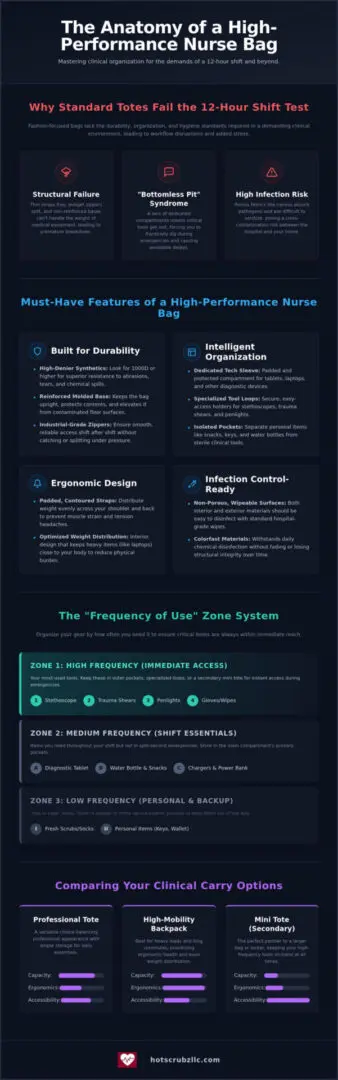
Fashion-focused bags often prioritize aesthetics over structural integrity. They lack the reinforced bases and high-denier synthetic fibers required to carry heavy medical equipment day after day. Over time, the physical demands of a 12-hour shift cause thin straps to fray and budget zippers to split. Beyond the physical breakdown, there’s a psychological cost. A disorganized bag forces you to make micro-decisions every time you reach for a tool. This contributes to decision fatigue, adding unnecessary mental weight to an already demanding role.
The Anatomy of Clinical Chaos
Standard bags often suffer from “bottomless pit” syndrome. Without dedicated compartments, your stethoscope, trauma shears, and penlights migrate to the dark corners of the bag. You’ll likely find yourself digging for high-traffic items during critical moments, which creates avoidable delays. The lack of internal structure means your bag collapses when placed on a flat surface, making it impossible to see your inventory at a glance.
Infection Control and Your Carry
The history of nursing uniforms shows a long evolution toward materials that prioritize hygiene and professional visibility. Your bag should follow the same logic. Porous fabrics like canvas or low-grade cotton act as magnets for pathogens and are nearly impossible to sanitize properly. In a clinical setting, cross-contamination is a constant risk.
Choosing a bag with a non-porous, wipeable interior is essential for maintaining safety standards. Whether it’s a leaked saline flush or a coffee spill, you need to be able to disinfect your gear instantly. A clean, well-maintained bag reflects your professional pride and ensures you aren’t bringing the ward’s microbes home with you. It’s about more than just storage; it’s about maintaining a sanctuary of organization in the middle of a busy shift.
Essential Features of a High-Performance Nurse Bag
Selecting a nurse tote bag for work requires looking far beyond the surface. Your bag is more than a container; it’s a mobile workstation that must remain functional under pressure. High-performance gear balances aesthetic appeal with functional endurance. You need high-denier synthetics, typically 1000D or higher, to provide the tensile strength required to carry stethoscopes, tablets, and heavy water bottles without sagging. Industrial-grade zippers are equally non-negotiable. They must resist the friction of being opened and closed dozens of times during a single shift without catching or splitting.
Effective compartmentalization acts as the backbone of your shift efficiency. A high-quality bag features dedicated zones: a protected tech sleeve for your diagnostic tablet, specialized loops for medical tools, and isolated pockets for personal essentials like snacks or a fresh pair of socks. This logical structure prevents the chaos of a disorganized interior. It ensures that every item has a fixed, visible home, allowing you to reach for what you need without breaking eye contact with a patient or colleague.
Materials That Survive the Ward
Synthetic blends generally outperform treated leather in high-stakes clinical environments. These modern textiles offer superior resistance to abrasions and harsh chemicals. Look for bags featuring slip-resistant, molded bases. These reinforced bottoms keep your bag upright and elevated from floor-level contaminants in locker rooms or shared breakrooms. In 2026, medical-grade durability is defined as a textile’s ability to withstand daily chemical disinfection without losing structural integrity or color fastness. This standard aligns with CDC guidelines on equipment safety regarding the maintenance of hygienic professional environments.
The Science of Ergonomic Carry
The weight of your gear shouldn’t become a physical burden. Choosing a nurse tote bag for work that prioritizes your health means looking at strap design. Non-padded straps often cut into the trapezius muscle, which leads to tension headaches and neck strain by the tenth hour. Padded, contoured straps distribute the load across a wider surface area to protect your body. Weight distribution is also vital for your long-term well-being. Always place the heaviest items, such as laptops or large diagnostic kits, in the compartment closest to your back to keep your center of gravity stable. For those who prefer a lighter, more focused setup for immediate access to shears and pens, a Mini Tote Bag offers an elegant, ergonomic solution for high-frequency tools.
Tote, Backpack, or Mini: Comparing Your Clinical Options
Every clinical specialty demands a different rhythm. Your choice of a nurse tote bag for work should reflect the specific pace of your environment. An ER nurse requires rapid mobility, while a home health clinician needs a portable office that can withstand various settings. Understanding the principles of ergonomics in nursing is the first step in deciding which bag silhouette will protect your physical health while enhancing your productivity.
Modern professionals generally choose between three primary styles. The classic tote remains a favorite for its spaciousness and traditional professional look. The nursing backpack has seen a surge in popularity for high-mobility roles because it keeps your hands free during patient transport or long commutes. Finally, the specialized Mini Tote Bag has emerged as a critical tool for floor-based organization, acting as a compact secondary station for your most-used items.
When to Choose a Classic Tote
A structured tote is the ideal companion for the clinician who values quick access and a sophisticated silhouette. It easily accommodates larger items like a laptop, a change of clothes, or a full lunch container. When you pair a high-quality tote with premium quality scrubs, you project an image of confident authority. While totes are excellent for commuters, they can lose stability when overstuffed. It’s vital to choose one with a reinforced bottom to prevent it from tipping over in the breakroom.
The Rise of the Clinical Mini Tote
Bulky bags can be a liability on a crowded ward. Many nurses are shifting toward a “hub and spoke” organization strategy. They leave their primary bag in a secure locker and carry a specialized mini tote to the bedside. This allows you to keep essential nurse accessories like tape, alcohol swabs, and trauma shears organized within a tiny footprint. The “grab-and-go” benefit is particularly evident during rapid response calls. You don’t have to waste seconds gathering tools; you simply pick up your mini tote and move. It’s a focused solution that prioritizes readiness and visibility without the physical strain of a heavy, oversized bag.
How to Organize Your Nursing Bag for Maximum Efficiency
Efficiency begins before you even step onto the ward. A nurse tote bag for work is your mobile command center, and its layout determines how smoothly your shift will run. You don’t just pack; you strategize. Start by sanitizing your current gear to 2026 standards. A quick wipe-down with hospital-grade disinfectant ensures your bag remains a safe zone. Audit your supplies to remove the clutter of past shifts, making room for the readiness you need today. A clean start leads to a focused mind.
Securing your medical tools is about protecting your investment and your patients. Stethoscopes and shears should never float freely. Use padded compartments to prevent damage and ensure they stay sterile. Creating a dedicated Self-Care Station for hydration and quick snacks keeps your energy levels stable during the mid-shift rush. A daily maintenance routine, consisting of a five-minute organization check at the end of every shift, prevents the buildup of clinical chaos. This habit ensures you’re always prepared for the unexpected.
The Frequency of Use Zone System
Divide your bag into three distinct areas to eliminate wasted time. Zone 1 consists of outer pockets. This is where you keep pens, pagers, and ID badges for immediate access. Zone 2 is the main compartment. It houses your stethoscope in a padded sleeve and a fresh pair of compression socks for nurses to swap into after a particularly long stretch on your feet. Finally, Zone 3 includes secure, zippered pockets for personal items like your wallet and keys. This separation ensures your personal life stays protected from clinical contamination while keeping your tools visible.
Packing for the 12-Hour Marathon
Endurance requires preparation. Dedicated side pockets for leak-proof water bottles are essential for staying hydrated without risking your electronics. Keep your diagnostic tablet in a raised tech sleeve to protect it from floor-level spills or clinical fluids. Many professionals also find it helpful to keep a backup pair of slip resistant nursing shoes in a ventilated bottom compartment. This preparation allows you to handle unexpected spills or long walks with total confidence. Ready to upgrade your organization? You can find your perfect clinical companion in our collection of specialized bags.
Maintaining Your Gear: Longevity and Professionalism
A high-quality nurse tote bag for work is an investment in your daily peace of mind. It isn’t just a purchase; it’s a commitment to your professional standards. To ensure your gear survives the rigors of 2026 clinical environments, consistent maintenance is essential. Daily exposure to hospital wards means your bag encounters a variety of pathogens and spills. By establishing a rhythm of care, you preserve the functional endurance of your tote while maintaining the polished look your patients expect.
Zipper and seam maintenance are the silent heroes of bag longevity. Industrial-grade hardware is durable, but it still requires attention. If a zipper feels sluggish, a tiny amount of graphite or specialized lubricant keeps it gliding smoothly. Inspect the seams monthly for signs of stress, particularly around the strap attachment points. Identifying a loose thread early can prevent a catastrophic failure during a busy shift. When a bag loses its structural integrity or develops permanent odors that resist cleaning, it’s time to retire it. Carrying a compromised bag risks both your supplies and your professional image.
Sanitation Protocols for the Modern Nurse
Your daily routine should include a rapid wipe-down with non-bleach disinfectant wipes. These are effective on most synthetic fabrics without stripping away protective water-resistant coatings. For odors, avoid heavy perfumes that can irritate sensitive patients. Instead, use natural deodorizers like activated charcoal inserts or baking soda sachets overnight. The ideal weekly deep-cleaning routine involves emptying all compartments, vacuuming the interior seams to remove debris, and applying a material-specific sanitizer to all high-touch surfaces. This deeper level of care ensures your nurse tote bag for work remains a hygienic sanctuary for your personal items.
Investing in Your Professional Future
Choosing high-quality accessories is a tangible form of career self-care. When you surround yourself with tools that work as hard as you do, you reduce the micro-stressors that lead to burnout. Your gear choices are directly connected to your clinical performance. A bag that stands upright, keeps your tools visible, and protects your physical health empowers you to focus entirely on patient care. Your complete uniform — from medical caps for nurses down to your footwear — reflects your dedication and shapes how you feel throughout a demanding shift. Your mission is vital, and you deserve equipment that rises to meet that challenge every single day. Select a bag that reflects your dedication, supports your rhythm, and empowers your journey through the healthcare landscape.
Step Into Your Shift With Confidence
Mastering clinical organization is about more than just finding a place for your gear; it’s about reclaiming your focus and energy. By choosing a nurse tote bag for work that prioritizes high-denier durability and ergonomic weight distribution, you protect your physical well-being. Implementing the “Frequency of Use” zone system ensures that every second counts when it matters most, while a steady maintenance routine keeps your equipment sterile and professional for years to come.
Your gear should be as resilient as your dedication to patient care. Elevate your clinical organization with HotScrubz Mini Tote Bags. Each piece is designed for clinical endurance, ensuring sophisticated style meets professional function in every high-stakes environment. Plus, enjoy free shipping on qualifying orders to get started on your path to a more organized workday.
You dedicate your life to others; it’s time to choose tools that support you in return. Step onto the ward with the assurance that everything you need is exactly where it should be. You’ve got this, and we’re here to help you carry the load with ease and elegance.
Frequently Asked Questions
What is the best material for a nurse tote bag?
High-denier synthetic fabrics like 1000D nylon or polyester blends are the gold standard for a nurse tote bag for work. These materials offer the tensile strength needed to carry heavy tools without sagging or tearing over time. They’re also non-porous, which makes them resistant to pathogens and easy to wipe down with hospital-grade disinfectants. Avoid canvas or cotton, as these materials absorb fluids and are difficult to sanitize properly.
How do I stop my nursing bag from hurting my shoulder?
To prevent shoulder strain, choose a bag with wide, contoured, and padded straps that distribute weight across a larger surface area. You should also pack your heaviest items, like tablets or diagnostic kits, in compartments closest to your back or body. This keeps your center of gravity stable. If your bag is consistently too heavy, consider using a Mini Tote Bag for floor essentials and leaving your larger bag in a locker.
Can I wash my nursing tote bag in a washing machine?
Most high-performance medical bags should not be placed in a washing machine. The agitation and heat can degrade protective water-resistant coatings and damage internal structural reinforcements like molded bases. Instead, use a soft cloth with warm, soapy water or non-bleach disinfectant wipes for regular cleaning. Always check the manufacturer’s label, but a manual wipe-down is the safest way to maintain the bag’s professional appearance and functional integrity.
How many pockets should a professional nurse bag have?
A professional nurse bag should ideally have six to eight dedicated pockets to maintain the Frequency of Use zone system. Look for at least one padded tech sleeve, two external pockets for rapid-access items like pens, and several internal dividers for stethoscopes and personal essentials. Having too many small pockets can lead to clutter, so prioritize a few well-placed, deep compartments that keep your gear visible and secure during a fast-paced shift.
What are the must-have items to keep in a nursing bag?
Your bag should contain a mix of clinical tools and personal care items. Essential gear includes your stethoscope, trauma shears, penlight, and a high-quality diagnostic tablet. Including specialized first aid supplies like Burn-Fix for rapid relief of burns or scalds is also highly recommended for clinical readiness. For personal endurance, pack a leak-proof water bottle, protein-rich snacks, and a fresh pair of compression socks. Keeping a backup pair of slip-resistant nursing shoes in a separate compartment is also a wise strategy for long shifts where spills or heavy walking are expected.
A backpack is often superior for high-mobility roles or long commutes because it keeps your hands free and balances weight across both shoulders. However, a structured tote is excellent for clinicians who prefer a traditional professional look and need quick, top-down access to larger items like laptops or lunch containers. Many nurses find the best balance by using a larger commute bag and a specialized Mini Tote Bag for focused floor-based organization.
How often should I sanitize my work bag?
You should perform a quick wipe-down of high-touch areas like handles and zippers at the end of every shift. This daily habit prevents the transfer of pathogens from the ward to your home environment. A more thorough deep cleaning, which involves emptying the bag and sanitizing the interior seams, should occur at least once a week. Maintaining this hygiene schedule protects your health and ensures your nurse tote bag for work remains a clean sanctuary.