Sub-Total: $0.00

Scrub Size Chart Conversion and Product-Specific Sizing
The same size label doesn’t guarantee the same fit across scrub products. A scrub size chart conversion starts with your chest or bust, natural waist, and hips, then matches those measurements to the chart for the specific top or pants you’re considering. Use each product’s chart instead of relying on one size label for everything.
It’s easy to expect one familiar size to work across an entire scrub set, but fit can vary by product and cut. This guide explains how to measure accurately, read product-specific charts, and choose what to do when your measurements fall between sizes.
You’ll find practical tips for comparing scrub tops and pants separately, considering fit and fabric, and checking pant length for comfortable coverage. With a clearer approach, you can choose scrubs suited to the demands of your shift.
Key Takeaways
- Use your chest or bust, waist, and hip measurements to find a starting size, then remeasure after body changes.
- Compare your measurements with the chart for each specific top or pair of pants; one size may not suit both.
- When deciding between sizes, consider the garment’s fit and fabric, as well as the ease of movement you want during a shift.
- Check scrub-pant length for comfortable coverage, and explore HotScrubz scrub tops and pants with your fit preferences in mind.
Choosing between sizes
Choose between scrub sizes by weighing your measurements, preferred ease, and the garment’s fit. For a scrub size chart conversion, compare the chart for each garment rather than relying on one label.
Selecting Between Measurement Ranges
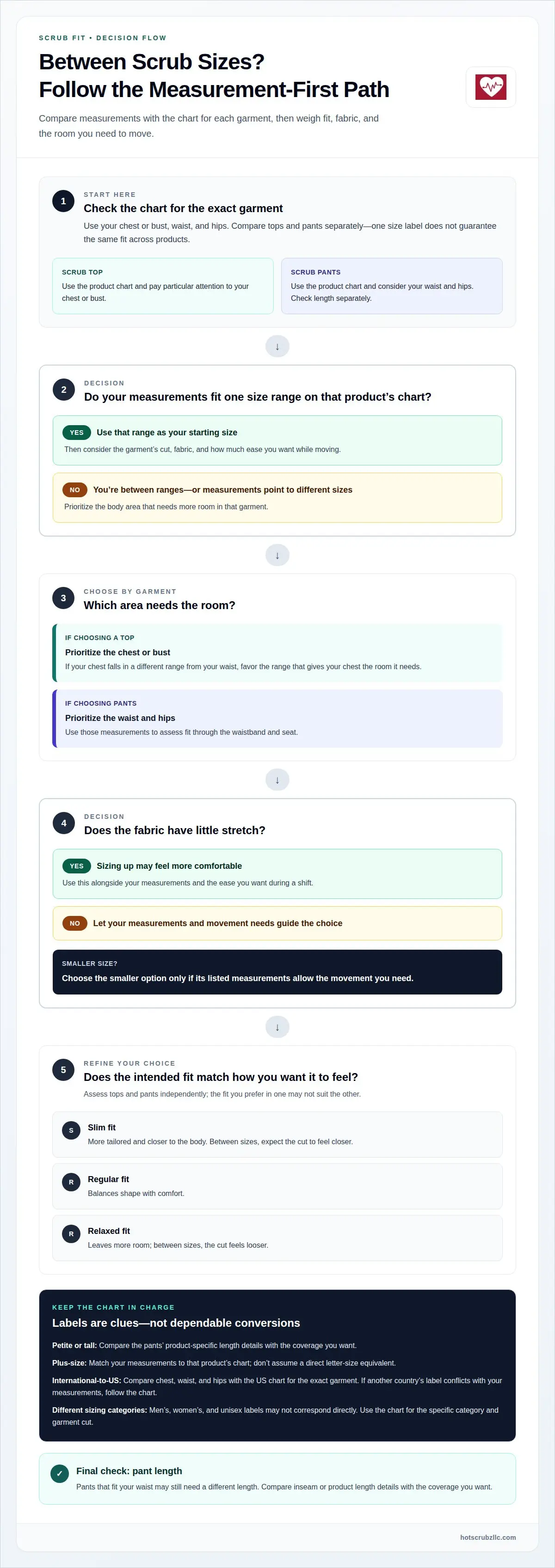
When you fall between sizes, select the option that best accommodates your measurements and movement needs. If your chest falls in one range and your waist in another, prioritize the measurement that needs more room in that garment. For a top, consider the chest; for pants, consider the waist and hips. If the fabric has little stretch, sizing up may feel more comfortable. Choose the smaller option only if its listed measurements allow the movement you need.
Regular, Relaxed, and Slim Fits
Fit describes how closely a scrub garment follows your body. Slim-fit scrubs are more tailored and close to the body, while regular-fit scrubs balance shape with comfort. Relaxed-fit scrubs leave more room. If you’re between sizes, let the intended fit guide your choice: a slim cut may feel closer, while a relaxed cut feels looser. Assess tops and pants separately, since the fit you prefer in one may not suit the other.
Petite, Tall, and Plus-Size Conversions
Petite, tall, and plus-size labels describe options designed for different proportions or measurement ranges. They don’t provide a dependable size conversion by label alone. For petite or tall pants, compare the product’s length details with the coverage you want. For plus-size options, match your body measurements to that product’s chart instead of assuming a direct letter-size equivalent. The label can narrow your choices, but the garment’s measurements and cut guide the final selection.
International-to-US Size Conversions
Converting an international size to a US size means matching one sizing system to a US product chart. Don’t rely on a single letter or number to translate between brands. Compare your chest, waist, and hip measurements with the US chart for the exact scrub garment, then consider its fit. If a size label from another country points to one size but your measurements match another, follow the chart measurements. This avoids treating unlike size labels as interchangeable.
What is a Scrub Size Chart?
A scrub size chart connects body measurements with a garment’s available size ranges. Read the chart for the specific cut and sizing system rather than treating labels as interchangeable.
Body Measurements and Size Ranges
A size range shows which body measurements correspond to each listed garment size. Compare your chest or bust, waist, and hips with the chart’s corresponding measurements, then find the range that accommodates them. Charts may use inches or centimeters, so follow the unit printed beside each measurement. If your body measurements change, take new ones before choosing again; older measurements may point to a different range.
Shrinkage varies with fabric and laundering conditions, so there’s no single reliable amount to expect for every scrub. Follow the garment’s care instructions, and don’t automatically size up to account for possible shrinkage.
Men’s and Unisex Measurements
Men’s and unisex scrub charts use body measurements to guide garment sizing, but their labels may not correspond directly. Match your chest, waist, and hips to the chart for that specific sizing category. For unisex sizing, don’t assume a familiar women’s or men’s letter size will fit the same way. The measurements and intended garment cut offer a more useful comparison than the label alone.
Women’s US Measurements
Women’s US scrub charts use measurement ranges to match body proportions with garment sizes. Compare your bust, waist, and hips with the relevant chart entries instead of relying only on a number or letter. If the chart suggests different sizes for different measurements, consider which area needs room in that garment. A top and pants may need different sizes because their fit depends on different parts of your body.
US Sizes and Letter Sizes
US-to-letter conversion means matching a numerical size or letter label to the measurements listed on a chart. There’s no universal conversion that applies across every scrub brand or garment. To convert, locate your measurements on the specific US chart, then use its corresponding letter or number. If a label conflicts with your measurements, use the chart’s ranges to guide your choice. Compare the measurements against the chart for the specific scrub tops and pants you’re considering.
Taking accurate chest, waist, and hip measurements
A flexible tape measure gives you the body measurements scrub charts use. Measure your chest or bust, waist, hips, and inseam before comparing a garment’s size range.
Chest and Bust Measurements
Your chest or bust measurement is the circumference around the fullest part of your upper body. Stand naturally and wrap a flexible tape around your chest or bust, keeping it level across your back. Let your arms rest at your sides, and keep the tape snug without pulling it tight. Record the measurement where the tape meets. For a scrub top, this helps you assess whether the garment has enough room across your upper body.
Waist and Hip Measurements
Waist and hip measurements describe the circumference of your midsection and lower body. Place the tape around your natural waist, where your torso bends, without drawing in your stomach. For your hips, measure around the fullest area, keeping the tape level from front to back. Record the results separately. Scrub-pant charts may use these measurements to guide the fit through the waistband and seat.
Inseam is the distance from the crotch area to the bottom of the leg. To measure it, stand straight and run the tape along the inside of your leg to your ankle or preferred pant length. Pants that fit your waist may still need a different length. Keep your inseam measurement separate when comparing pant charts.
For consistent results, take each measurement over lightweight clothing or close-fitting garments. Keep the tape parallel to the floor for chest, waist, and hip measurements. Avoid measuring over bulky layers, which can affect the reading. If the tape slips or twists, reset it and measure again. Record each result in the chart’s stated unit, such as inches or centimeters, rather than estimating or rounding. Use your notes to compare tops and pants with their respective charts.
Checking product-specific size charts
A product-specific size chart connects measurements to the sizing of one garment or style. Use the chart for the exact scrub top or pants you’re considering, because a familiar size label alone doesn’t show how that item will fit.
Size charts can differ across scrub brands, so don’t assume a label transfers directly from one brand to another. Compare your measurements with the chart for each product, paying attention to its stated ranges and intended fit.
Scrub tops and pants may use different charts, so choose a size for each separately. A top depends on upper-body measurements, while pants sizing also involves your waist, hips, and length. Use this practical sequence to read a chart without relying on the label alone:
- Identify the product. Make sure the chart applies to the specific top or pants, not just a general category.
- Match the measurements. Compare your chest or bust, waist, and hips with the chart’s stated ranges.
- Check the units. Confirm whether measurements use inches or centimeters before comparing values.
- Review the cut. Slim, regular, and relaxed fits can feel different, even when a chart points to the same size.
- Check pant length. Compare inseam or length information with your preferred coverage, especially if you need petite or tall proportions.
If the top chart points to one size but the pants chart points to another, follow each product’s guidance. That’s a practical fit choice, not a mismatch. If you fall between ranges, consider which area needs more room and whether the fabric has stretch. Your measurements and the intended fit can guide your decision.
Keep a note of the product name, size, and fit that work for you. Revisit the chart when choosing another style, since product details matter. Explore scrub tops and pants with these chart checks in mind.
HotScrubz
HotScrubz offers scrub tops, scrub pants, lab coats, and medical footwear for healthcare professionals. Use the measurement and chart comparisons in this guide to make a more informed choice from its professional apparel. Check the size chart for each garment, since tops and pants can fit differently and may call for separate sizes. Consider your preferred fit and the measurements that matter most for each item. A considered choice can support comfort and confidence through a demanding shift. For help choosing from HotScrubz’s offerings, contact HotScrubz.
Make Your Next Fit Choice with Confidence
Build your next purchase on what you’ve learned about your fit. Keep a note of the cuts and measurements that feel comfortable, then use it as a starting point when comparing another garment. A thoughtful scrub size chart conversion is more than matching labels; it helps you make a considered choice for the work ahead. Your preferred fit may differ with another style, so let each product’s chart guide your decision.
When you’re ready to choose, HotScrubz is a place to explore professional apparel with your fit preferences in mind. If you’d like support with your next step, contact HotScrubz for sizing help. Move forward with a choice that feels comfortable, considered, and ready for your day.
Frequently Asked Questions
Tips for Getting the Perfect Fit Every Time?
Use the garment’s own chart, then check how it fits during everyday movements. Try reaching forward, bending, and sitting to see whether the fabric pulls or restricts you. For a coordinated set, assess the top and pants separately instead of choosing one shared size. Note the sizes and cuts that feel comfortable, so you have a useful reference next time.
What body measurements are needed to choose scrub size?
Most scrub size charts use chest or bust, waist, and hip measurements; pants charts may also include inseam. Record each measurement with its unit, such as inches or centimeters, to avoid mixing values. A simple note on your phone can keep them together. If a chart asks for a measurement you haven’t recorded, take it before choosing instead of estimating from another garment’s label.
How should you size scrubs for a comfortable fit or layering?
Choose a size that leaves room for the layer you plan to wear underneath, such as a lightweight shirt, while still matching the garment’s chart. If you’ll wear scrubs over your usual work clothes, measure with that layer on or account for its added bulk. Don’t automatically choose a larger size: the cut and fabric affect how much room the garment provides. Check that you can move comfortably.