Sub-Total: $0.00

Nursing Shoes for Flat Feet: The 2026 Guide to Shift-Long Comfort
Did you know that the average nurse walks approximately five miles during a single 12-hour shift? For those living with flat feet, every one of those miles can feel like a direct challenge to your endurance, often resulting in persistent arch pain or lower back fatigue. You deserve a foundation that works as hard as you do without forcing a choice between clinical stability and personal style. We believe your professional appearance should feel as light and effortless as your care is compassionate.
Finding the right nursing shoes for flat feet is about more than just softness; it’s about finding the structured support that prevents overpronation. This guide explores the 2026 landscape of medical footwear, focusing on options that meet the ASTM F2913-24 slip resistance standards while offering the durability to handle hospital spills. You’ll discover how to select shoes that provide shift long comfort, ensuring you remain focused on your patients rather than your feet. From understanding deep heel cups to evaluating modern silhouettes, we’ll help you step into your next shift with renewed confidence and ease.
Key Takeaways
- Understand why “structured redirection” is the essential mechanism for preventing arch collapse and overpronation during high-mileage shifts.
- Identify the specific medial post and firm heel counter features that define the most effective nursing shoes for flat feet.
- Compare the distinct benefits of stability sneakers and professional clogs to match your footwear to the unique physical demands of your clinical unit.
- Learn how to verify 2026 safety standards for slip resistance and fluid protection to ensure your foundation is as safe as it is supportive.
- Discover the total support system that combines ergonomic footwear with compression accessories to minimize swelling and elevate your professional style.
Understanding Flat Feet and the Nursing Professional
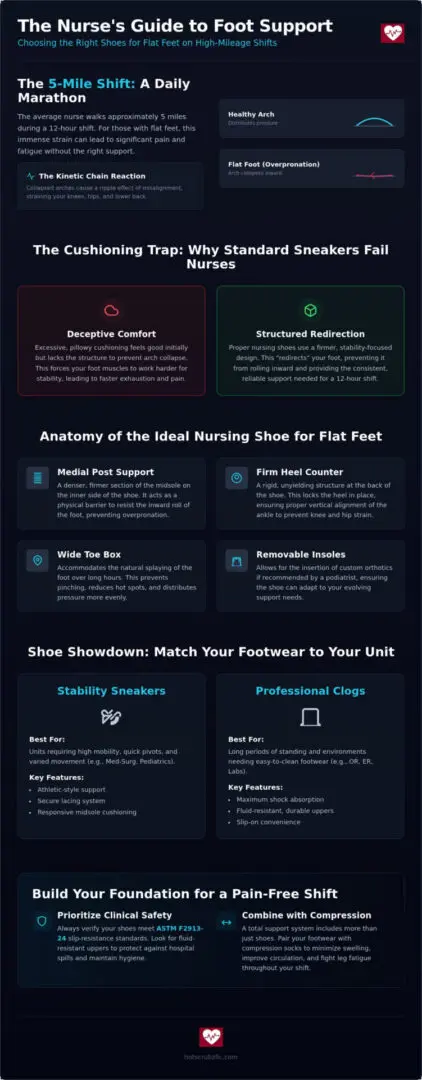
Your feet are the silent partners in every patient interaction. For a medical professional, Understanding Flat Feet is the first step toward reclaiming your energy at the end of a long day. This condition, known clinically as pes planus, occurs when the longitudinal arches of the feet collapse, causing the entire sole to make contact with the ground. On a typical shift where you might cover five miles of hospital corridor, this lack of natural suspension becomes a significant hurdle to your physical well-being.
The impact of flat feet isn’t contained to your soles. It’s a matter of the kinetic chain. When your arches lack structural integrity, your body compensates by shifting the burden of impact to your joints. This creates a ripple effect where misaligned feet lead to strained knees, tilted hips, and a persistent ache in your lower back. Without the right nursing shoes for flat feet, you aren’t just fighting foot fatigue; you’re fighting a systemic alignment issue that can shorten your career longevity.
The Reality of Overpronation in the Ward
Constant standing on unforgiving hospital floors puts roughly three times your body weight in pressure on your arches. This environment accelerates overpronation, which is the inward rolling of the ankle during the gait cycle. You might notice early signs of this before the pain becomes chronic. Watch for these indicators of foot fatigue during your rounds:
- A localized burning sensation in the midfoot or arch area.
- A feeling of “heavy” or leaden legs that starts halfway through your shift.
- Visible wear on the inner edges of your shoe soles.
- Persistent tightness in your calves that doesn’t resolve with rest.
Why Standard Sneakers Often Fail Nurses
Many popular sneakers prioritize “fashion” or a “cloud-like” feel that can be deceptive. While excessive, pillowy cushioning feels comfortable for the first ten minutes, it often lacks the medial structural support necessary for a collapsed arch. For someone with flat feet, a shoe that’s too soft is like walking on sand; it forces your muscles to work harder to find stability, leading to faster exhaustion. High-performance nursing shoes for flat feet differ from standard trainers by offering a firmer midsole that prevents the foot from sinking into an inward roll. You need a stability-focused design rather than a neutral gait shoe to provide the “redirection” your bones require. Investing in footwear that understands this biomechanical need ensures you remain as focused and effective as the care you provide.
Key Features to Look for in Nursing Shoes for Flat Feet
Choosing the right foundation requires a discerning eye for specific engineering. When shopping for nursing shoes for flat feet, you aren’t just looking for a “comfortable shoe.” You are looking for a tool that manages the physical demands of occupational foot safety while maintaining your professional edge. The right features act as a silent support system, allowing you to focus on patient care rather than your own discomfort.
Medial Post Support: This is the “secret sauce” for stability. It’s a denser section of the midsole located on the inner side of the shoe. It acts as a physical barrier against overpronation by resisting the inward roll of the foot. This keeps your foot in a neutral position throughout your shift, protecting your kinetic chain from the ground up.
Firm Heel Counters: A heel counter is the rigid structure at the back of the shoe. For flat feet, this must be firm and unyielding. If you can easily squeeze the back of the shoe, it won’t provide the necessary alignment. A locked-in heel ensures your ankle remains vertical, preventing the “tilting” that often leads to knee and hip strain.
Wide Toe Boxes: Flat feet tend to splay or widen when weight is applied over long hours. A narrow shoe will cause pinching and hot spots by hour six. Look for designs that allow your toes to spread naturally, which helps distribute pressure more evenly across the foot. High-quality medical footwear often incorporates these wider silhouettes to accommodate the natural expansion of the foot during a 12-hour shift.
Removable Insoles: Your support needs might evolve. Having a shoe with a removable footbed gives you the flexibility to add custom orthotics if your podiatrist recommends them. This ensures the shoe remains a long-term investment in your health.
Arch Support vs. Arch Contouring
There’s a significant difference between a shoe that fits the shape of your foot and one that actually supports it. A soft, squishy arch might feel pleasant during a quick try-on, but it offers no resistance to the weight of a full day on the ward. True arch support should feel like a “firm handshake” for your foot. It provides constant, reliable pressure that prevents the arch from bottoming out. Anatomical footbeds mimic the shape of a healthy arch, providing a template that keeps your foot in its most efficient posture.
The Role of Midsole Technology
The material under your foot determines how you’ll feel by hour ten. EVA foam is popular for being lightweight and responsive, while PU foam often lasts longer for nurses working 40 hours or more per week because it resists compression. This durability ensures your “energy return” stays consistent, fighting that heavy-leg feeling. Additionally, a low heel-to-toe drop provides a more stable base for standing. It reduces the strain on your forefoot and calves, keeping you ready for whatever the next call bell brings.
Stability Sneakers vs. Professional Clogs: The Flat Foot Debate
The choice between a sleek stability sneaker and a traditional professional clog often defines your experience of the workday. For those seeking nursing shoes for flat feet, this isn’t merely a matter of aesthetics; it’s a strategic decision based on how you move across your unit. While sneakers offer the agility required for rapid response in the ER, clogs provide a rigid fortress for those who spend hours anchored to a single spot in the OR or lab. Both styles have earned their place in the clinical environment, yet they serve different biomechanical purposes for the low-arched professional.
Weight and durability are the primary trade-offs in this debate. Stability sneakers are generally lighter, reducing the energy cost of every step during your five-mile shift. However, they may require replacement more frequently as the foam compresses under the weight of overpronation. In contrast, professional clogs often feature high-density PU foam and leather uppers that offer a superior return on investment. They maintain their structural integrity for years, though their heavier weight can occasionally lead to leg fatigue if you aren’t accustomed to the lift. Selecting the right nursing shoes for flat feet requires balancing these practical needs with your daily reality.
When to Choose a Stability Sneaker
Stability sneakers excel in high-activity roles where you are constantly pivoting and accelerating. These shoes utilize “motion control” technology to guide your foot into a neutral path, preventing the inward roll we discussed earlier. The presence of laces is a critical advantage here. Laces allow you to customize the tension across your midfoot, ensuring a secure fit that prevents your foot from sliding inside the shoe. If you find your feet splaying significantly by hour eight, the adjustable nature of a sneaker provides the necessary room without sacrificing support. For a deeper look at the latest performance models, check out our Best Nursing Shoes for Long Shifts: 2026 Guide.
The Case for Rigid Professional Clogs
Professional clogs are designed with a rigid rocker bottom that facilitates a smooth transition from heel to toe. This design is particularly beneficial for flat feet because it reduces the amount of work your arches and forefeet must do to propel you forward. Many clogs also feature a slightly elevated heel, which can relieve the constant tension on the Achilles tendon that often accompanies a collapsed arch. Beyond the orthopedic benefits, clogs offer a distinct hygiene advantage. Their smooth, non-porous surfaces allow for quick decontamination after spills, ensuring you stay focused on your patient’s health while maintaining your own professional standards.
Clinical Safety Meets Orthopedic Support
Professional excellence requires a foundation that is as safe as it is supportive. You shouldn’t have to compromise your physical stability to ensure your clinical safety. While we’ve discussed the biomechanical needs of lower arches, those features must exist within a package that handles the unpredictable environment of a hospital. A shoe with elite arch support is only effective if it remains firmly planted on the ground, regardless of what’s been spilled in a patient’s room.
Weight distribution plays a subtle but vital role in your daily safety. Stability-focused nursing shoes for flat feet often incorporate denser materials to prevent overpronation. However, if this weight isn’t balanced correctly, it can lead to “clipping” or tripping as you move quickly during a code. Modern engineering in 2026 ensures that medical footwear remains lightweight enough for agility while providing the heavy-duty support your kinetic chain requires. It’s a harmony of physical ease and professional responsibility.
The Importance of Slip-Resistant Outsoles
There is a significant difference between a shoe that feels “grippy” and one that is certified for clinical environments. When searching for nursing shoes for flat feet, look for footwear that meets the ASTM F2913-24 standard, which is the current benchmark for slip resistance. When a floor is slick, your body makes thousands of tiny micro-adjustments to maintain balance. For those with flat feet, these adjustments are particularly taxing because the muscles are already working overtime to compensate for a collapsed arch. A certified slip-resistant base provides the peace of mind needed to move with confidence, reducing cumulative fatigue by the end of your shift.
Hygiene and Longevity for Flat Foot Footwear
The fluids you encounter daily can do more than just stain your shoes. If liquids penetrate the upper material, they can degrade the supportive foams and medial posts that keep your feet aligned. Fluid-resistant uppers protect your investment and your health. Simultaneously, breathability is essential to prevent heat build-up. Excess heat leads to swelling, which can make even the best-fitting shoes feel restrictive and painful by mid-afternoon. To maximize longevity, we recommend the “two-pair rotation” rule. High-density foams typically need 24 hours to fully decompress and regain their original shape. By alternating your footwear, you ensure the stability features are fully functional every time you clock in.
Even with perfect care, every shoe has a lifespan. Most experts suggest the “500-mile rule” for replacement. Since the average nurse walks five miles per shift, your stability features may begin to “die” after about 100 shifts. If you notice your knees aching or your arches feeling less “held” than usual, it’s likely time for a fresh pair. You can explore our full range of medical footwear to find a pair that meets these rigorous standards of safety and support.
The Total Support System: Footwear, Socks, and Care
Your journey to shift-long comfort doesn’t end with a pair of stability shoes. To truly master the physical demands of your environment, you must view your footwear as one part of a total support system. For those with lower arches, the goal is a holistic approach that manages pressure, circulation, and recovery in equal measure. By integrating high-performance nursing shoes for flat feet with targeted accessories, you create a foundation that empowers your professional performance from the first patient check-in to the final handover.
The Power of Compression
Flat feet are uniquely susceptible to edema, or swelling, because the collapse of the arch can hinder the efficient return of blood flow from the lower extremities. When your feet splay under the pressure of a 12-hour shift, fluid often pools in the ankles and midfoot. Pairing your stability footwear with high-quality compression socks creates a dual-action defense. While the shoe provides the structural redirection your bones need, the sock provides the external pressure required to keep blood moving. This combination effectively eliminates that leaden, heavy-leg feeling that often sets in by hour ten. You can learn more about these critical additions in our Essential Nurse Accessories: The 2026 Guide.
True care for your feet also involves active recovery. Because flat feet often lead to tight calves, taking five minutes after your shift to stretch your gastroc and soleus muscles can significantly relieve plantar pressure. This simple habit prevents the “pulling” sensation that often mimics or leads to plantar fasciitis. While over-the-counter insoles can provide immediate relief, persistent pain or severe overpronation may require a visit to a podiatrist for custom orthotics. These bespoke inserts fit perfectly into the removable footbeds of your stability shoes, providing a medical-grade solution tailored to your unique anatomy.
Investing in Your Professional Well-being
We believe that high-quality footwear is a vital tool for clinical excellence, not just a workplace expense. When you step onto the ward in a complete HotScrubz set, you aren’t just dressed for work; you are equipped for success. A unified look that pairs supportive nursing shoes for flat feet with polished scrubs boosts your confidence and projects the image of an authoritative, caring professional. It strikes a balance between physical ease and professional responsibility. Your feet carry you through every challenge and victory of your career. Treating them with the respect they deserve ensures you remain ready to care for others for years to come.
Step Into Your Next Shift with Confidence
Your focus should be on your patients, not the persistent ache in your arches. We’ve explored how the right stability features, like medial post support and firm heel counters, provide the structured redirection your feet need to handle five-mile shifts. By combining high-performance nursing shoes for flat feet with a total support system of compression and active recovery, you transform your workday from a test of endurance into a showcase of professional excellence. Clinical safety and orthopedic support are no longer mutually exclusive; they’re the twin pillars of your daily performance.
You deserve a foundation that reflects your dedication and protects your long-term health. At HotScrubz, we provide a curated selection of high-performance medical apparel and footwear designed with empathetic support for healthcare heroes like you. Take advantage of free shipping on qualifying orders to build a professional wardrobe that empowers every step. Elevate your shift with professional footwear at HotScrubz. Your career is a marathon of compassion, and we’re here to ensure you walk it with ease, visibility, and enduring style.
Frequently Asked Questions
Can flat feet cause back pain for nurses?
Yes, flat feet are a primary source of lower back pain due to the kinetic chain. When your arches collapse, your ankles roll inward, forcing your knees and hips out of alignment. This shift tilts your pelvis and places excessive strain on your lumbar spine. For a professional walking five miles a day, this cumulative stress results in chronic back fatigue that persists long after your shift ends.
How often should I replace my nursing shoes if I have flat feet?
You should generally replace your nursing shoes for flat feet every 500 miles or approximately every 100 shifts. Because flat feet put more pressure on the medial side of the shoe, the supportive foams and posts compress faster than they would for a neutral gait. If you notice your arches feeling less “held” or see visible wear on the inner edges of the sole, it’s time to invest in a fresh pair.
Do I need custom orthotics, or are stability shoes enough?
Stability shoes are often sufficient for most professionals with flexible flat feet. They provide the necessary medial posting to prevent overpronation during high-activity shifts. However, if you have rigid flat feet or experience persistent pain despite wearing supportive medical footwear, you should consult a podiatrist. They can determine if you need custom orthotics to replace the removable insoles found in high-quality stability models for a more personalized level of correction.
Are memory foam shoes good for flat feet?
Memory foam is usually not recommended for flat feet because it’s too soft. While it feels pleasant initially, memory foam lacks the structural integrity to prevent your arch from bottoming out. For shift-long comfort, you need firmer materials like high-density PU or EVA foam. These provide a “firm handshake” for your foot, offering the resistance needed to keep your skeletal structure aligned during long periods of standing and walking.
What is the best way to clean fluid-resistant nursing shoes?
The best way to maintain fluid-resistant nursing shoes for flat feet is to wipe them down with a damp cloth and mild soap or clinical disinfectant wipes after every shift. Avoid saturating the interior, as excess moisture can break down the supportive materials over time. Regular cleaning doesn’t just ensure hygiene; it preserves the integrity of the uppers, ensuring your stability features remain functional and your professional appearance stays polished.
Should I buy a half-size larger for long shifts?
Buying a half-size larger or choosing a wide width is often beneficial to accommodate natural foot swelling. During a 12-hour shift, your feet can expand significantly due to gravity and constant standing. A slightly larger shoe prevents pinching and hot spots while allowing your toes to splay. Just ensure the heel remains locked in place, as a loose heel counter can lead to instability and painful friction blisters during your rounds.
Can I wear high-arch support shoes if I have flat feet?
You should avoid shoes designed for high arches, as they often have rigid, aggressive bumps that can cause bruising or pain on a flat foot. Instead, look for stability or motion control shoes. These designs focus on a flatter, firmer medial post that supports your existing structure without forcing it into an unnatural shape. The goal is to redirect your gait rather than propping up a non-existent arch with hard plastic.
Is it better to have laces or slip-on shoes for flat foot support?
Laces are generally better for flat feet because they allow you to customize the tension across your midfoot. This ensures your foot doesn’t slide inward during overpronation. However, slip-on clogs with a rigid rocker bottom are excellent for roles involving prolonged standing. If you choose a slip-on, ensure it has a firm heel counter and a deep heel cup to provide the necessary stability without the need for adjustable laces or straps.