Sub-Total: $0.00

Best Nursing Shoes for Long Shifts: 2026 Guide
Did you know that slips, trips, and falls account for over 25% of all workplace injuries in healthcare? It is a sobering reality you face every time you step onto a slick hospital floor. You deserve to feel secure in your stride without sacrificing the professional style you have worked so hard to cultivate. We understand that by the tenth hour of your shift, your focus should be on your patients, not the growing ache in your arches or the fear of a fluid spill. Finding the right pair of slip resistant nursing shoes is more than a simple shopping choice; it is a vital investment in your daily well-being and your long-term career longevity.
You shouldn’t have to choose between the cushioned ease of a high-end sneaker and the rigorous safety standards of a clinical environment. This 2026 guide reveals how to select footwear that balances sophisticated aesthetics with the technical grit required for demanding wards. We will explore the latest ASTM F2913 certified models and ergonomic designs that transform how you experience your longest shifts. From advanced cushioning to sleek, wipeable finishes, you will discover how the right foundation empowers you to move through your workday with total confidence and professional grace.
Key Takeaways
- Discover why your choice of footwear is a foundational tool for protecting your body and musculoskeletal health during demanding 12-hour shifts.
- Learn to identify the specific technical certifications that distinguish high-performance slip resistant nursing shoes from standard professional footwear.
- Explore the clinical benefits of various styles to find the perfect harmony between your personal aesthetic and the rigorous requirements of your department.
- Master a simple testing technique to ensure your shoes accommodate natural swelling; it’s the best way to guarantee lasting comfort from clock-in to clock-out.
- Gain practical insights on maintaining your footwear to preserve both its sophisticated appearance and its essential safety features.
The Foundation of Care: Why Footwear Choice Defines Your Shift
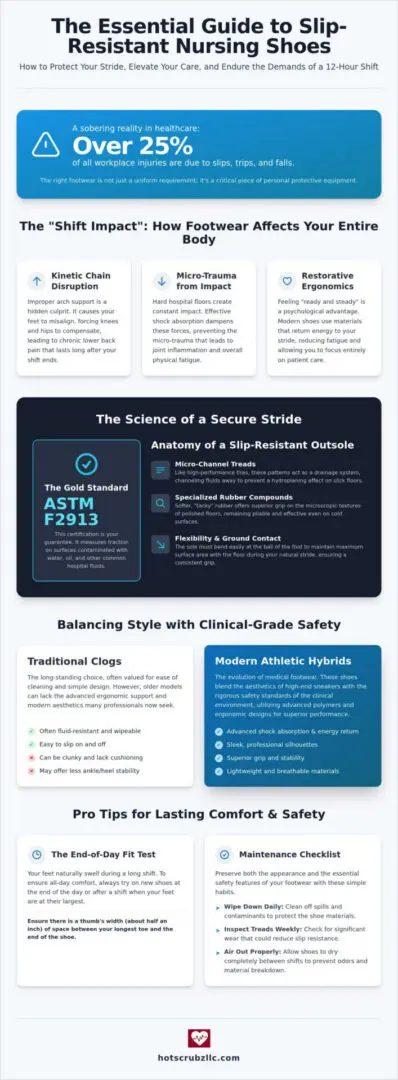
Your footwear is far more than a uniform requirement. It’s a precision instrument designed for occupational health. Think of your shoes as the foundational tool of your clinical practice, as vital as your stethoscope or your scrubs. When you spend 12 hours navigating the fast-paced environment of a hospital, the “Shift Impact” on your body is significant. It’s the cumulative load on your musculoskeletal system that begins at the base of your heels and travels all the way to your neck. Choosing high-quality The Science of Slip Resistant Nursing Shoes ensures you have the stability needed to handle every emergency with poise.
There is also a profound psychological benefit to feeling “ready and steady.” In high-stakes environments, your focus should remain entirely on your patients. If you’re subconsciously worrying about a slick floor or a sudden spill, you’re not fully present. This is where the concept of restorative ergonomics changes the game. Modern footwear design has evolved beyond simple protection. It now focuses on active recovery, using materials that return energy to your stride and reduce the overall fatigue felt by the end of a long rotation.
The Physical Toll of Clinical Endurance
Improper arch support is often the hidden culprit behind chronic lower back pain. When your feet aren’t correctly aligned, your entire kinetic chain suffers. Your knees and hips rotate inward to compensate, leading to referred pain that lingers long after you’ve clocked out. Shock absorption plays an equally critical role. By dampening the impact of every step on hard hospital floors, specialized footwear prevents the micro-trauma that causes joint inflammation. Maintaining your professional posture becomes effortless when your foundation is built for endurance.
Balancing Aesthetic Pride with Functional Safety
You shouldn’t have to compromise your personal style for the sake of workplace safety. For too long, medical professionals were forced into clunky, uninspired clogs that felt disconnected from their lifestyle. Modern manufacturing has changed that. We now see sleek, athletic silhouettes that utilize advanced polymers to meet rigorous hospital standards. You can now find slip resistant nursing shoes that look as sharp as your favorite weekend sneakers while providing the grip you need. Medical-grade footwear is the intentional intersection of clinical-grade safety and restorative physical support. Pairing the right footwear with carefully chosen essential nurse accessories creates a complete professional kit that supports both your performance and your personal identity on the ward.
The Science of Slip Resistant Nursing Shoes and Stability
The “slip-resistant” label isn’t just a marketing claim; it’s a technical designation backed by rigorous safety standards. When you’re searching for slip resistant nursing shoes, you’re looking for the ASTM F2913 certification. This specific standard measures how well a shoe maintains traction on surfaces contaminated with water, oil, or chemical prep solutions. High-performance outsoles rely on a sophisticated combination of tread geometry and rubber chemistry to keep you upright when floors become hazardous. It’s the difference between a confident stride and a dangerous stumble during a critical moment.
Tread patterns act like a drainage system for your feet. Much like high-performance tires prevent a car from skidding on a rainy highway, “micro-channel” treads create paths for fluids to escape. This design prevents the hydroplaning effect, where a thin layer of liquid sits trapped between your shoe and the polished tile. In a hospital environment, where spills are unpredictable, these channels are your primary defense. Specialized rubber compounds further enhance this by offering a softer, more “tacky” feel that grips the floor’s microscopic textures better than standard athletic foam.
Understanding Outsole Traction Patterns
A superior outsole doesn’t just have a pattern; it has a purpose. Specialized slip-resistant compounds use a specific rubber density that remains pliable even on cold, hard floors. While harder rubber might last longer on outdoor pavement, it’s dangerously slick on wet indoor surfaces. You need a balance of flexibility and consistent ground contact. Use this quick checklist when evaluating your next pair:
- Flexibility: The sole should bend easily at the ball of the foot to maintain maximum surface area with the floor.
- Pattern Density: Look for a high frequency of small, repeating shapes rather than large, flat blocks.
- Edge Grip: Ensure the tread extends to the very edge of the sole to provide traction during side-to-side movements.
Stability Beyond the Sole: Lateral Support
Traction is only half the battle. If your foot slides inside the shoe during a quick turn, you risk a painful ankle strain. This is why a reinforced heel counter is essential. This rigid structure wraps around the back of your heel to prevent “rolling” during the rapid movements required in emergency situations. This lateral support works in tandem with your entire uniform to keep you agile and focused. Just as you choose the Essential Guide to Scrubs Scrub Tops for their range of motion, your shoes must facilitate quick, confident pivots. If you’re ready to upgrade your clinical kit, explore our curated selection of medical footwear designed for the modern professional.
Comparing Styles: Clogs, Sneakers, and Athletic Footwear
Choosing the right silhouette is a strategic decision based on your specific clinical environment. It isn’t just about what looks best in the locker room mirror; it’s about how the shoe interacts with the unique hazards of your ward. Whether you’re navigating the sterile halls of a surgical suite or the high-energy pace of the ER, your slip resistant nursing shoes must match your movement patterns. Understanding the technical differences between these styles helps you invest in the tool that best supports your specific role.
The Classic Clog: Protection and Ease
Traditional clogs remain a cornerstone of medical attire for good reason. In environments where fluid exposure is a constant reality, the solid, wipeable uppers of a clog provide an essential barrier. The “rocker bottom” design is specifically engineered to assist with your natural gait, rolling the foot forward to reduce fatigue during long hours of standing. These silhouettes offer a sense of professional permanence. They pair perfectly with a Professional Lab Coat, creating a look that is both traditional and highly functional for specialists who prioritize protection and ease of maintenance.
Athletic Nursing Sneakers: Agility for the Ward
For those in high-mobility roles, athletic nursing sneakers offer the agility needed to respond to any situation. These designs focus on lightweight materials and maximum breathability, ensuring your feet stay comfortable even during the most frantic shifts. If you’re frequently walking miles across a large hospital campus, the impact-reducing memory foam found in these sneakers is a lifesaver. Lace-up models provide a customized, secure fit for rapid movements, while slip-on athletic designs offer convenience for quick changes without the hassle of untied laces during a code.
We’re also seeing the rise of a hybrid category. These shoes blend a polished, professional aesthetic with the hidden technology of a performance runner. When deciding on your next pair, consider your primary tasks. If your day involves more standing than sprinting, the structural support of a clog is often superior. If you’re constantly on the move, the flexibility of an athletic trainer will serve you better. Finding the best slip resistant nursing shoes for long shifts means matching the technical specs of the outsole to the specific demands of your clinical rotation. Use this framework to decide:
- Choose Clogs: Best for OR staff, labor and delivery, or any role with high fluid exposure and extended standing.
- Choose Sneakers: Best for ER, pediatrics, or floor nurses who cover significant distances every shift.
- Choose Hybrids: Best for administrators or specialists who need a sophisticated look without sacrificing sneaker-like comfort.
How to Evaluate and Maintain Your Professional Footwear
Your professional footwear is a high-performance tool. Like any specialized equipment, it requires regular evaluation to ensure it continues to protect you. Maintaining your slip resistant nursing shoes isn’t just about appearances; it’s about preserving the technical features that keep you safe. Follow these five steps to ensure your foundation remains secure.
First, perform the “Afternoon Fit Test.” Your feet naturally swell during a long shift. Checking the fit of your shoes after several hours of movement ensures they won’t become restrictive when you need comfort most. Second, examine the midsole and heel for structural integrity. If you notice the foam feels brittle or lacks its original “bounce,” the restorative properties have likely faded. Third, evaluate the tread. Flattened patterns are a clear signal that your traction is compromised. Fourth, establish a consistent cleaning routine to prevent chemical buildup. Finally, implement a “Two-Pair Rotation” strategy. Alternating between two pairs allows the internal foam to fully decompress, which can extend the life of both shoes.
Signs of Structural Fatigue
Foam compression is a silent thief of comfort. Over time, the microscopic air pockets in the midsole collapse, which significantly reduces shock absorption. You might notice visual cues like “sole separation” at the edges or a visible flattening of the tread pattern. Most medical shoes require replacement every 6-9 months for optimal health. Waiting longer risks referred pain in your joints and back. If your current pair feels “flat,” it is time to upgrade to professional-grade footwear that supports your clinical endurance.
Sanitization and Fluid Resistance Maintenance
A clean shoe is a safe shoe. For leather uppers, a simple damp cloth and mild soap preserve the material’s integrity. Synthetic and mesh uppers benefit from specialized cleaning solutions that won’t degrade the fibers. Using protective sprays can help maintain stain-resistance against common hospital spills and prep solutions. Don’t overlook the importance of moisture-wicking socks. They work in tandem with your slip resistant nursing shoes to maintain overall foot hygiene and prevent internal material breakdown from moisture. By caring for your footwear, you ensure you remain ready for every challenge your shift presents. For female clinicians looking to combine long-term durability with all-day ease, exploring comfortable nursing shoes for women designed for 2026 performance standards is an excellent next step. Completing your clinical wardrobe with the right essential nurse accessories for 2026 clinical excellence ensures every element of your professional kit works together to support your stamina and confidence throughout the most demanding rotations.
Elevate Your Performance with HotScrubz Medical Footwear
Your career is defined by the care you provide, but your daily performance is fueled by how you feel. At HotScrubz LLC, we believe you shouldn’t have to sacrifice your personal identity for professional safety. We act as your stylish, supportive ally, curating a collection that prioritizes your emotional and physical well-being. By choosing the right slip resistant nursing shoes, you’re making a clear statement that your health is just as important as the health of your patients.
We’ve intentionally moved away from the cold, sterile atmosphere of traditional medical supply stores. Instead, we offer a lifestyle-oriented experience that celebrates your dedication. Our selection isn’t just about utility; it’s about visibility, prestige, and professional pride. We’ve done the hard work of vetting brands and styles so you can shop with total confidence. Building a complete professional wardrobe, from stethoscopes to footwear, has never been more seamless or inspiring. Understanding how to look professional in scrubs is an essential part of projecting the clinical excellence that complements your investment in premium footwear.
The HotScrubz LLC Commitment to Quality
Our selection process is rigorous and purposeful. We look for footwear that meets the highest standards for durability and clinical-grade safety. Every pair in our collection is chosen for its ability to withstand the unique pressures of a high-stakes workplace. We understand that a shoe is only as good as the support it provides in the final hour of a long rotation. This commitment to quality ensures that your focus remains on your clinical responsibilities, not your physical discomfort.
Beyond the products, we offer empathetic support to help you navigate your choices. Whether you have questions about sizing for natural swelling or need advice on which style suits your specific ward, our team is here to guide you. We’re authoritative experts who function as friendly allies. We ensure you feel seen in your hard work and inspired to elevate your professional appearance through carefully curated choices.
Ready for Your Next Shift?
Investing in premium support is an investment in your career longevity. When your feet are secure and your body is aligned, your professional confidence naturally rises. You deserve a wardrobe that works as hard as you do, from your moisture-wicking socks to your clinical footwear. Experience the difference that intentional design and restorative ergonomics can make in your daily routine.
It’s time to prioritize your physical ease and elevate your professional presence. We invite you to Explore our curated selection of slip resistant nursing shoes and discover the perfect foundation for your next shift. Your journey toward better shift-work endurance and refined style starts right here.
Step Into Your Future with Confidence
You’ve explored how the intersection of technical safety and restorative ergonomics transforms your daily shift. From understanding the grip of ASTM F2913 certified outsoles to choosing between the protective ease of clogs or the agility of athletic sneakers, your footwear is now a strategic asset. Remember that your foundation requires regular care and timely replacement to maintain its peak performance. Investing in high-quality slip resistant nursing shoes is a commitment to your long-term health and your professional pride.
At HotScrubz, we curate sophisticated styles designed for 12-hour shift endurance. We provide national US shipping on professional apparel to ensure every modern clinician has access to premium support. You deserve a professional kit that reflects the high standards of care you provide every day. Our guide to comfortable nursing shoes for women built for 2026 comfort and performance is an ideal resource for female healthcare professionals seeking the perfect balance of style and clinical-grade support. Find your perfect pair of high-performance nursing shoes at HotScrubz and experience a new level of clinical ease. We are proud to stand as your ally as you continue to care for others with grace and strength.
Frequently Asked Questions
How do I know if my nursing shoes are truly slip-resistant?
You can verify the safety of your footwear by looking for the ASTM F2913 certification mark. This technical standard ensures the shoe has been tested for traction on surfaces contaminated with water, oil, and chemical solutions. Truly slip resistant nursing shoes often feature this designation on the tongue or packaging. This certification provides the peace of mind you need to move confidently through every emergency.
Are clogs or sneakers better for nurses with plantar fasciitis?
Clogs are generally better for managing plantar fasciitis due to their rigid structural support and elevated heel. While sneakers provide immediate soft cushioning, the firm arch support found in professional clogs prevents the foot from over-pronating. This stability reduces the constant tension on the plantar fascia ligament. By maintaining a neutral foot position, you can significantly decrease the chronic pain felt after a long rotation.
How often should healthcare professionals replace their work shoes?
Healthcare professionals should replace their work footwear every 6 to 9 months to maintain optimal musculoskeletal health. Even if the outer soles show minimal wear, the internal cushioning materials lose their ability to absorb shock over time. Once the midsole foam compresses, it no longer protects your joints from the hard hospital floors. Regularly updating your foundation prevents referred pain in your knees and lower back.
What features should I look for in shoes for a 12-hour shift?
Focus on finding a pair that offers a wide toe box, high-rebound cushioning, and a secure heel counter. These features accommodate the natural foot swelling that occurs during a 12-hour rotation while providing the lateral stability needed for quick movements. You should also prioritize lightweight materials that reduce leg fatigue. A shoe that balances these ergonomic benefits with professional style, much like the curated selections at Daily Foot Wear, will keep you feeling ready for any challenge.
Can I use my own orthotic inserts in professional nursing shoes?
Most modern medical footwear is designed with removable insoles to accommodate custom orthotic inserts. This flexibility allows you to pair the specialized safety of slip resistant nursing shoes with the precise support your podiatrist recommends. When shopping, ensure the shoe has enough internal volume to house your orthotics without feeling restrictive. This combination provides a personalized fit that enhances your comfort throughout the most demanding shifts.
How do I clean my nursing shoes to prevent hospital-acquired odors?
Clean your shoes with a mild detergent and warm water, then follow up with a disinfectant spray specifically formulated for footwear. For leather or synthetic uppers, using a wipe to remove surface contaminants after every shift prevents organic materials from causing persistent odors. It’s also helpful to remove the insoles and allow the shoes to air out completely between rotations to maintain a fresh, professional environment for your feet.
Are waterproof shoes necessary for all nursing roles?
Waterproof shoes are essential for high-fluid environments like the OR or ER, but they offer benefits for all nursing roles. Having a wipeable, fluid-resistant surface protects you from accidental spills and makes daily maintenance much easier. While outpatient roles might allow for more breathable mesh, most clinicians prefer the added security of a non-porous material. This ensures your footwear remains pristine and professional regardless of the situation.
Does HotScrubz offer national shipping for medical footwear?
HotScrubz proudly offers national shipping across the entire United States for our full range of medical footwear and apparel. We understand the importance of having reliable, high-performance gear no matter where you practice. Our streamlined online shopping experience makes it easy to equip yourself with the tools you need for clinical excellence. We are committed to acting as your ally by delivering premium support directly to your door.